Generative Engine Optimization in India: What 300 Real AI Queries Reveal About Brand Visibility
One funded D2C grocery startup. One established organic retail chain. Both fully indexed. One had 1.8% AI search visibility. Here is what GEO actually looks like when you measure it.
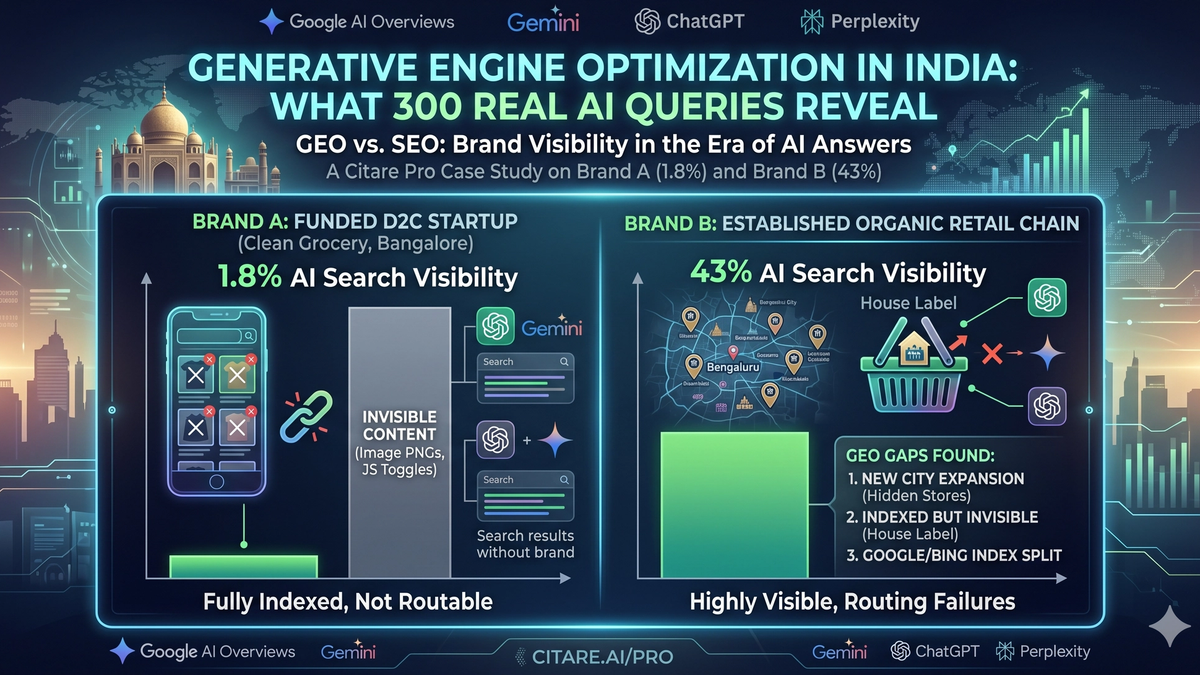
Most Indian brand teams are still optimizing for Google rank position. That problem is real — but it is no longer the only problem. A second search layer has arrived: Google AI Overviews, ChatGPT, Gemini, and Perplexity now answer customer questions before the user ever reaches a results page. Optimizing for that layer is called Generative Engine Optimization — GEO — and most Indian brands have not measured it yet.
We did.
At Citare, we measure AI search visibility for consumer brands: what AI platforms actually say when a real customer asks a real question, across real customer personas, with geo-targeted queries. Over two weeks, we ran our full measurement pipeline on two Indian food brands — 300+ AI queries across five customer personas, three platforms, ten queries each. Both brands are fully indexed. Both have strong press. Neither knew what their AI search visibility number actually was before we ran this.
Here is what generative engine optimization looks like when the data is in front of you.
What is GEO — and why it is different from SEO
Traditional SEO optimizes for rank position in a list of links. GEO — Generative Engine Optimization, also called LLM SEO or Answer Engine Optimization (AEO) — optimizes for whether an AI platform cites, mentions, or recommends your brand when generating an answer.
The distinction matters for one structural reason: Google AI Overview, ChatGPT, Gemini, and Perplexity ground their answers against different indices. Google AI Overview and Gemini pull from Google's index. ChatGPT grounds against Bing's. Perplexity uses its own crawler. A brand can rank first on Google and be completely absent from ChatGPT — not because ChatGPT is wrong, but because Bing has not indexed the content that carries the brand's story.
This means AI search visibility is four independent measurement problems, not one. Our methodology treats them that way.
Brand A: A funded D2C startup with 1.8% AI search visibility
(Vertical: clean-label quick-commerce grocery, Bangalore, institutional funding, nine-figure valuation)
Organic AI surface rate across 56 dispatches: 1.8%. One query. One platform. One win.
This is not a brand with a press problem. Economic Times, TechCrunch, Inc42, YourStory, Moneycontrol — all indexed. A founder interview with nearly a million YouTube views. 276 brand-relevant mentions captured in a single week. When we named the brand directly to any AI platform, every platform responded accurately and in detail.
The AI search visibility gap was not awareness. It was format.
The brand's primary differentiator — a framework banning 200+ ingredients across food, personal care, and home products — existed exclusively as PNG image cards on their website. Google AI Overview, ChatGPT, and Gemini cannot read images. Every claim that made this brand defensible against every competitor in its category was locked in a format structurally invisible to the AI layer.
Meanwhile, a competitor had taken the same positioning language — "no palm oil," "clean label," "banned ingredients" — and published it as crawlable text. On Gemini, that competitor held Brand A's positioning slot. Same differentiation. One brand published it as text. One published it as PNG. This is a GEO problem, not a brand problem.
The four-index reality, surfaced on one query: The same "no palm oil grocery Bangalore" query returned Brand A ranked first on Google AI Overview, the competitor in Brand A's slot on Gemini, and zero brand awareness on ChatGPT. Three AI platforms. Three different outcomes. One query. One week. This is why treating AI search visibility as a single number is structurally misleading.
Brand B: An established retail chain with 43% AI visibility — and three GEO blindspots
(Vertical: curated organic grocery retail, 10+ stores in primary city, expanding to second city)
Organic AI surface rate across 150 dispatches: 43%. Nine of ten named-comparison queries won. The brand is known, indexed, and consistently recommended on Gemini and Google AI Overview for its primary market.
By every conventional measure, this brand is winning at AI search. Which is why the three GEO gaps we found are more useful to understand than the 1.8% finding. They reveal what "indexed but not routable" looks like in practice — the most common GEO failure mode for established brands.
Gap 1: New-city expansion is AI's most dangerous blindspot
The brand has four live stores in its second city, confirmed by Google Maps and founder-provided data. For direct factual queries about those stores, Google AI Overview returns no answer at all — not wrong, absent. Gemini names the stores correctly at the research stage of a conversation, then contradicts itself three exchanges later in the same session, telling the user the brand has no physical stores in that city. ChatGPT is internally consistent when asked directly, but for the exploratory queries a new-city shopper actually starts with — "organic grocery delivery near me," "clean food for Jain family in this neighbourhood" — the brand does not appear.
Root cause: the store-locator page uses a JavaScript city-toggle UI. AI crawlers cannot activate UI toggles. The structured address data is unreachable. A static store page with LocalBusiness JSON-LD schema — one day of engineering — closes all three platform-specific failure modes from a single content edit.
For any Indian brand in the middle of a new-city or new-market expansion: your AI search visibility in that market is almost certainly zero, regardless of your Maps presence or press coverage, until you publish crawlable structured content for that market.
Gap 2: Indexed but invisible — the most common GEO failure mode
The brand's homecare house label is fully indexed on both Google (Gemini-grounded) and Bing (ChatGPT-grounded) at product depth. When we escalated our probes, both platforms described the product line accurately: formulation, ingredient standards, delivery routes, category coverage.
For the most direct category-qualifier query — "chemical-free home cleaning delivery Bangalore" — ChatGPT returned nine competing brands with the house label absent. Gemini returned three. The brand's content was indexed at depth on both platforms. The routing was broken.
This is the core GEO challenge that differs from conventional SEO. A brand can be fully indexed and still fail at generative engine optimization because the query vocabulary customers use does not connect to the brand content AI platforms hold. The fix is a vocabulary bridge: a dedicated landing page with delivery-intent language, category-qualifier terms, and product schema that creates the path from "what the customer types" to "what the AI knows."
Gap 3: The Google-Bing index split
The brand's partner-brand provenance story — rural cooperative sourcing, traditional grain partnerships, ethical producer networks — surfaces correctly on Gemini and Google AI Overview. It is invisible on ChatGPT.
This is the Bing-versus-Google index split that affects every Indian brand whose story lives primarily as press coverage rather than owned-domain content. Google's index crawled the press-side connection. Bing did not. Since ChatGPT grounds against Bing, the brand's values narrative simply does not exist on that platform — regardless of how well it performs on Gemini.
The GEO fix is on-site content: a page on the brand's own domain that explicitly connects partner brands to specific store locations gives Bing a crawlable, owned-domain source for the association. It closes the ChatGPT gap without touching Gemini's existing correct behavior.
The three GEO lessons that apply to every Indian consumer brand
1. Indexed is not the same as visible, and visible is not the same as routable.
Both brands are indexed. One is visible. Neither is fully routable. These are three distinct layers of AI search visibility failure, and conventional SEO tools measure none of them directly. GEO measurement requires dispatching real queries from real customer personas and auditing what AI platforms actually produce — not modeling what they should produce.
2. Your most defensible brand asset may be your biggest AI visibility liability.
Brand A's ingredient ban framework is its most defensible competitive claim. It lives in PNG images. Brand B's homecare label is its most exclusive product. It lacks a URL with category-qualifier vocabulary. The content formats chosen for visual brand presentation — image cards, toggle UIs, modal drawers, scrolling infographics — are systematically inaccessible to the AI layer. Generative engine optimization requires that brand differentiators exist as crawlable text before they can influence AI responses.
3. Google AI Overview, ChatGPT, Gemini, and Perplexity are four separate GEO problems.
Same brand, same query, same week: first on Google AI Overview, displaced by a competitor on Gemini, zero awareness on ChatGPT. Treating AI search visibility as a single score is as misleading as treating "search rank" as a single number across Google, Bing, and DuckDuckGo. Each platform grounds against a different index and produces structurally different results. Knowing which gap lives on which platform — and why — is the prerequisite for any GEO fix that actually works.
What the fixes look like
None of the recommendations from either run required new campaigns or new brand stories. Every fix was a content vocabulary bridge:
- Convert PNG ingredient cards to schema-marked crawlable text
- Publish a static store page with LocalBusiness JSON-LD for every new-market entry before launch, not after
- Give house brands and partner brands dedicated URLs on the brand's own domain with category-qualifier, delivery-intent vocabulary
- Add regional-language grain terminology (Kannada, Tamil, Telugu) to millet and grain product pages so vernacular queries route to English-keyed brand content
Generative engine optimization in India is still an unclaimed discipline. Only 16% of brands globally track AI search performance systematically. India-specific measurement is rarer still. The brands that establish measurement now — and close the measure → fix → prove loop — will hold a structural advantage that is very difficult to close retroactively.
We measure AI search visibility for Indian D2C brands, consumer startups, and SaaS companies building global presence. If you want to know your own number — not modeled, not estimated, measured across real customer personas and real AI platforms — this is what Citare Pro does.
citare.ai/pro