GEO vs SEO: What's the Difference and Why Both Matter
GEO optimizes for AI platforms. SEO ranks pages on Google. They overlap, diverge, and both matter. Full structural breakdown.
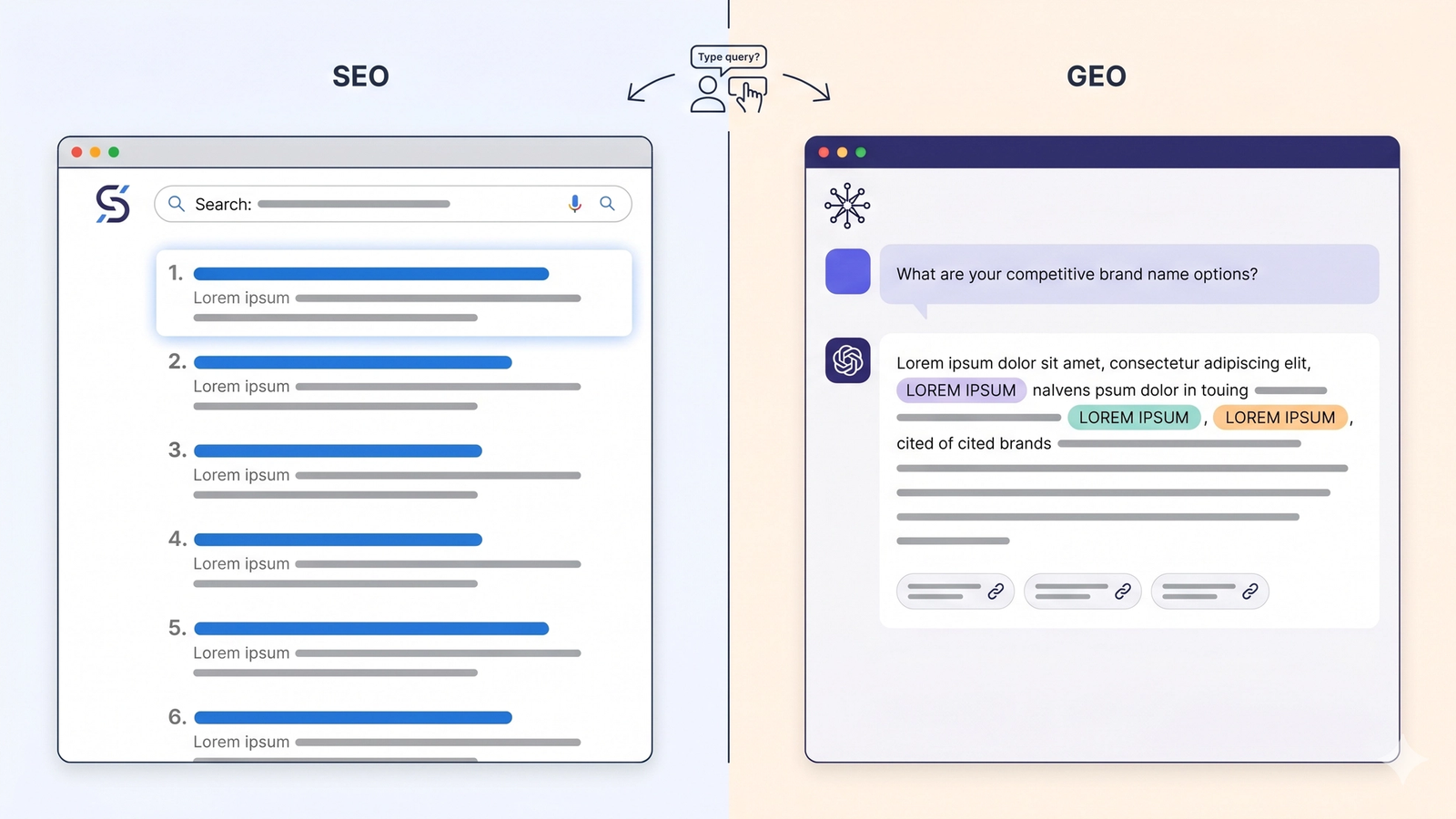
The question is being asked in every marketing meeting right now: "Is SEO dead? Do we need to switch to GEO?"
The answer is neither. SEO is not dead. GEO is not optional. They are two different optimization disciplines targeting two different surfaces of brand discovery — and any brand serious about visibility in 2026 needs both.
This guide breaks down the structural differences between Generative Engine Optimization (GEO) and Search Engine Optimization (SEO), where they overlap, where they diverge, and how to build a unified visibility stack that works across Google's link results and AI platforms like ChatGPT, Gemini, Perplexity, and Google AI Overview.
If you have not yet read What is Generative Engine Optimization (GEO)? The Complete Guide, start there for foundational concepts. This guide assumes familiarity with what GEO is and focuses on the comparison.
The Simplest Definition
SEO optimizes individual pages to rank higher in Google's link-based search results.
GEO optimizes brands and content to be cited in AI-generated answers across ChatGPT, Gemini, Perplexity, and Google AI Overview.
SEO produces a position number. GEO produces a citation rate. SEO works at the page level. GEO works at the brand level. SEO has 25 years of tooling and best practices. GEO is two years old and changing every month.
Both are about being found. They just operate on different surfaces with different rules.
The Seven Structural Differences
- **Goal** — SEO: Rank a page in a list of links · GEO: Get the brand cited in a generated answer
- **Ranking unit** — SEO: The page (URL) · GEO: The brand (entity)
- **Index source** — SEO: Google's index (one) · GEO: Google + Bing + Perplexity's own (multiple)
- **Output type** — SEO: Ranked link list (10 blue links) · GEO: Synthesized natural-language answer with optional citations
- **Update cadence** — SEO: Real-time crawl + reindex · GEO: Crawl + model training cycle (slower drift correction)
- **Success metric** — SEO: Rank position, organic traffic · GEO: Surface rate, citation share, brand mention frequency
- **Failure mode** — SEO: Position drops; traffic loss · GEO: Zero citation; brand absent from answer entirely
The most important row in this table is the third one. Traditional SEO is monolithic — one index, one set of ranking signals, one optimization target. GEO is fragmented — three or four different indexes powering different platforms, each with its own crawl coverage and citation logic. This is why a brand can rank #1 on Google and be invisible on ChatGPT: ChatGPT does not query Google's index.
Why "LLM SEO," "AEO," "AI SEO," and "GEO" All Mean Roughly the Same Thing
The terminology is messy because the practice is new. Here is the disambiguation:
- GEO (Generative Engine Optimization) — current dominant term, coined to specifically describe optimizing for generative AI search platforms. Most precise.
- LLM SEO — emphasizes that the optimization target is large language model-based search. Used interchangeably with GEO.
- AEO (Answer Engine Optimization) — predates GEO. Originally referred to optimizing for voice search and featured snippets. Now used broadly for AI answer optimization. Often synonymous with GEO.
- AI SEO — informal umbrella term. Less precise but commonly used.
For consistency, this guide uses GEO. If you encounter the others in vendor pitches or content, treat them as equivalent unless context suggests otherwise. The underlying practice — making your brand citable by AI systems — is the same regardless of label.
Where SEO and GEO Overlap
GEO is not a replacement for SEO. The foundation is shared. If your SEO is broken, your GEO will be broken too.
1. Crawlability Both depend on machine access to your site. A page blocked by robots.txt cannot rank in Google and cannot be cited by AI. The foundation is the same: clean robots.txt, working sitemap.xml, server-rendered or pre-rendered HTML, no infinite redirects, no 5xx errors during crawl.
2. Topic authority Google rewards depth on a topic; AI platforms cite brands that demonstrate expertise on a topic. The mechanism is different but the input is similar — comprehensive, well-structured, accurate content on a focused subject area.
3. Structured data Google has used schema.org markup for years to power rich results, knowledge panels, and featured snippets. AI platforms now use the same structured data to extract citable facts. JSON-LD that already powers SEO rich results doubles as JSON-LD for AI visibility.
4. E-E-A-T signals Experience, Expertise, Authoritativeness, Trustworthiness — Google's content quality framework. AI platforms apply analogous filters when deciding which sources to cite. Author bylines, organizational credibility signals, original research, and editorial processes matter on both surfaces.
5. Site speed and Core Web Vitals Slow-loading pages get crawled less frequently and indexed shallower. This affects both Google rank and AI citation eligibility. The technical SEO checklist — Core Web Vitals, mobile rendering, HTTPS — applies equally to GEO.
If you are spending zero on SEO, you cannot win at GEO. The shared foundation is non-negotiable.
Where SEO and GEO Diverge
This is where most teams get confused. The tactics that move SEO needles often have minimal or zero impact on GEO. Inversely, GEO requires interventions that traditional SEO playbooks ignore.
1. Backlinks Matter Less for GEO
Backlinks are the spine of Google's PageRank-derived ranking. They matter much less for AI citation. AI platforms evaluate content credibility through the source itself — author identity, content depth, publication freshness, structured data — not through how many other sites link to it. A brand with a small backlink profile but high semantic completeness can outrank a backlink-rich competitor in AI citation.
This does not mean backlinks are useless for GEO — high-authority backlinks still help indirectly through indexing speed and credibility signals. But the leverage is much lower than in SEO.
2. Keyword Density Is Irrelevant
SEO's relationship with keyword density has been weakening for a decade, but it is still a common optimization frame. For GEO, it is essentially moot. AI models evaluate semantic completeness, not keyword frequency. Writing the phrase "best CRM software" twenty times on a page does not increase its likelihood of being cited when ChatGPT is asked about CRM tools. Covering the topic comprehensively from multiple angles does.
3. Schema Markup Priority Is Much Higher for GEO
In SEO, schema markup is a "nice to have" that improves rich result eligibility. In GEO, structured data is one of the highest-leverage interventions. AI platforms parse JSON-LD preferentially over body text for factual claims. A FAQ schema block can make a page citable for dozens of question-style queries. An Organization schema with comprehensive sameAs links can become the canonical brand entity reference an AI uses.
If you have to choose where to invest first in GEO, structured data is usually the highest-ROI starting point.
4. Bing Index Health Matters Only for GEO
Most SEO teams have ignored Bing for years because it represents a small fraction of search volume. In GEO, Bing health is critical: ChatGPT's web search grounds against Bing's index. A brand that is well-indexed on Google and poorly indexed on Bing will be visible in Google AI Overview and invisible on ChatGPT — a pattern we see frequently in brand audits.
Submitting your sitemap to Bing Webmaster Tools and verifying Bingbot is allowed in robots.txt is now GEO infrastructure work.
5. Internal Linking Has a Different Shape
SEO internal linking optimizes for PageRank flow within a site. GEO internal linking optimizes for topic graph completeness — making sure every facet of a topic is interconnected so an AI can navigate the cluster and synthesize comprehensive answers. The pillar + cluster content architecture serves both, but the GEO emphasis is on semantic relationship, not link equity.
6. Content Length and Format Pressure Different Behaviors
SEO has long rewarded long-form content (3,000+ words) for competitive queries. GEO rewards completeness, not length. A 1,500-word page that fully covers a topic with structured FAQ blocks, comparison tables, and clear definitions can outperform a 5,000-word page that meanders. AI platforms parse and excerpt — they do not reward total word count.
7. Update Cadence Matters Differently
Google reindexes content within hours of publication. AI platforms have slower drift correction — a model trained six months ago may still be citing a competitor that has since gone out of business. This means GEO has a longer lag between optimization and visible result. It also means brand-name recognition built in AI training data is a moat that compounds over time.
Why Your Google Rank Doesn't Predict AI Visibility
This is the most counterintuitive finding for teams new to GEO measurement.
Independent industry research shows that 62% of pages cited in Google AI Overview do not rank in the top 10 organically for the query that surfaced them. This is not a small gap. It means the majority of AI citations go to pages that traditional SEO would not even prioritize.
The reason: AI platforms select sources for synthesis quality, not for click-through likelihood. A page deep in Google's index with strong semantic structure, clear factual claims, and comprehensive topic coverage can be a better citation candidate than the #1 ranking page that happens to win on backlinks.
Brand audits we have run reveal this gap repeatedly. A D2C food brand ranking #1 for its core category on Google surfaced in just 1.8% of relevant AI queries — beaten in AI citation by smaller competitors with stronger structured data and richer comparison content. An established Indian organic retail brand achieved a 43% AI surface rate while smaller competitors with stronger Google rankings dropped under 5%.
Your Google rank is a useful signal but it is not a predictor. You need a separate AI search presence tracker to know where you actually stand on AI platforms.
The Measurement Gap: Why Traditional SEO Tools Don't Track GEO
Every major SEO platform — Ahrefs, Semrush, BrightEdge, Moz, Sistrix — was built around Google rank tracking. They tell you where your pages sit in the SERP, how that has moved, and what your competitors are doing. None of them natively track AI citation.
This is the source of the GEO monitoring tool alternative category. Teams running on Semrush or BrightEdge are increasingly asking: "How do I see what's happening on ChatGPT and Perplexity?" The answer is that traditional SEO platforms do not surface this at all. Some have begun adding AI Overview tracking, but coverage of ChatGPT, Gemini, and Perplexity remains thin or non-existent in the legacy stack.
A proper AI search monitoring tool needs to:
- Dispatch real queries across ChatGPT, Gemini, Perplexity, and Google AI Overview — not infer visibility from proxy signals
- Run persona-anchored prompts — the same query produces different results for different user personas, and a serious AI visibility tracker captures that variance
- Compute surface rate as a primary metric — percentage of dispatches in which the brand is named or cited
- Benchmark against named competitors — knowing your surface rate matters less than knowing the gap between you and the brand winning the citations
- Track citation context — was the brand recommended, compared favorably, or mentioned as a deprecated option
This is what an AI brand visibility platform looks like, and it is structurally different from a traditional SEO suite. Treating GEO measurement as an SEO add-on misses the point.
For agencies, the pattern is even more pronounced. A client AI visibility reporting tool that produces standalone GEO reports — alongside traditional SEO reports — is now table stakes. White label AI search monitoring, where agencies brand the report as their own deliverable, is a growing category. AI visibility tool for agencies as a search query has gone from non-existent to meaningful volume in twelve months.
In India specifically, the gap is wider. Most brands run on Semrush or Ahrefs and have zero visibility into their AI search presence. Citare's positioning as an AI search intelligence platform India was built specifically because no incumbent tool covered this surface for Indian brands. AI visibility tool India is currently a small but rapidly growing segment, with most demand coming from D2C, SaaS, and digital agencies.
Building the Unified Brand Visibility Stack
The right framing is not SEO vs GEO. It is one stack with two surfaces.
Foundation Layer (shared)
- Technical health: clean robots.txt, sitemap.xml, no crawl errors, mobile rendering, HTTPS
- Site architecture: logical URL structure, working internal links, no orphan pages
- Core content: comprehensive, factually accurate, well-edited
- Schema markup: Organization, LocalBusiness (if applicable), Product, Article, FAQ as relevant
- Page performance: Core Web Vitals in green
This layer serves both SEO and GEO. Every brand needs it.
SEO-Specific Layer
- Keyword research and on-page optimization
- Backlink acquisition (link building, digital PR, guest posts)
- Featured snippet optimization
- Local SEO (GBP, citations, reviews) for brick-and-mortar
- Content velocity: regular publishing to maintain freshness signals
GEO-Specific Additions
- Bot access verified for GPTBot, ClaudeBot, PerplexityBot, Google-Extended (full AI crawler access guide in [P4 → How to Measure AI Search Visibility])
- JSON-LD for AI visibility — prioritized FAQPage, HowTo, Product, Organization schemas with comprehensive properties
- Bing Webmaster Tools submission and Bing index health monitoring
- llms.txt published at site root with brand summary and key topic anchors
- Content moved out of images: any brand claim, certification, or differentiator currently locked in PNG cards needs an on-page text equivalent
- AI search monitoring tool deployed for ongoing surface rate tracking
- Persona-based query dispatch as a regular measurement cadence
- Competitor brand audit — quarterly comparison of your surface rate against named competitors
This is the unified stack. Most brands today have a complete SEO-specific layer and zero GEO-specific layer. Closing that gap is what GEO work in 2026 actually is.
What This Means for Your Team
The GEO build-out implicates different team functions in different ways.
For In-House SEO Teams
Your remit is expanding. You now own AI search visibility alongside Google rank. The metrics, tools, and reporting cadence need to expand to match. Block time monthly to run query dispatches across AI platforms. Add an AI Visibility section to your monthly SEO report. Familiarize yourself with the four AI platforms and how they source content differently.
For Content Teams
GEO content optimization is a meaningful shift. AI search content optimization rewards semantic completeness over keyword stuffing, structured Q&A formats, comparison tables, and explicit factual claims tied to authoritative sources. Content teams that adopt a GEO content strategy tool early — using AI platforms themselves to identify gaps in topic coverage — will produce more citable content.
The single highest-leverage content shift is moving from "blog posts about a topic" to "comprehensive resources structured for both human reading and machine extraction." Same content quality, different format. Content visibility on AI platforms depends on this format shift more than on any other single change.
For Digital Marketing Agencies
GEO is rapidly becoming a client retention moat. Clients are asking "where do I appear on ChatGPT" in pitch meetings. Agencies that cannot answer this lose accounts to those that can. Standing up an AI visibility tool for agencies workflow — quarterly brand audits, surface rate dashboards, AI citation reports — is now a strategic priority for agency growth, not an experimental add-on.
White label AI search monitoring solutions allow agencies to deliver branded GEO reports without building the underlying measurement stack, which has accelerated agency adoption significantly in 2026.
For Indian SMBs
The opportunity is asymmetric. Most Indian SMBs have weak SEO foundations (JS-heavy sites, missing structured data, image-locked content) and have done zero GEO work. The first Indian SMB in any local category to invest in an AI search tool for Indian SMBs and clean up their site for AI crawlers will dominate AI search results in that vertical for years. How to appear on AI search India is one of the highest-leverage questions an Indian SMB can ask in 2026, and answering it requires structured GEO investment that almost no competitor will yet have made.
Decision Framework: Where to Focus First
Not every brand should approach SEO and GEO with the same balance. Use this framework:
New brand, just launched
Priority: SEO foundation first, GEO foundation in parallel. Get the technical health right, publish foundational content, claim your brand entity (Google Business Profile, Wikipedia where appropriate, Crunchbase, LinkedIn), and instrument both Google Search Console and an AI visibility tracker from day one. Do not wait for SEO to be "done" before starting GEO measurement — the data over time is what makes GEO actionable.
Established brand losing traffic
Priority: investigate AI cannibalization before assuming SEO decline. A brand seeing a 20% YoY traffic drop in 2026 may not have an SEO problem. They may have an AI Overview cannibalization problem — Google is generating answers directly in the SERP, satisfying intent without the user clicking through. Before re-optimizing pages, run an AI search presence audit to see whether your queries are being absorbed by AI Overviews and whether your brand is being cited in those Overviews.
B2B SaaS
Priority: GEO is now top of funnel. B2B buyers ask AI platforms for category recommendations during evaluation. A SaaS brand that does not appear in ChatGPT's recommendation set for its category is losing pipeline. SaaS GEO work — ensuring named-competitor visibility, building structured comparison content, optimizing case study pages for AI citation — is now a top-of-funnel investment with measurable conversion impact.
Local/SMB with physical presence
Priority: structured local data, both SEO and GEO. LocalBusiness JSON-LD, Google Business Profile completeness, NAP consistency across directories — these serve both SEO local pack rankings and AI platform local citations. The same structured data investment unlocks both surfaces.
D2C brand
Priority: get content out of images, then layer in research. Most D2C brands have product differentiators (ingredients, certifications, sourcing, sustainability claims) locked in PNG cards. The first GEO action is to extract that content into on-page text. Once that foundation is in place, original research and comparison content drive AI citation.
Frequently Asked Questions: GEO vs SEO
Is SEO dead?
No. Google still drives the majority of organic discovery for most brands and will continue to for years. What is changing is the share — AI platforms are absorbing some queries entirely, especially informational and recommendation queries. SEO is becoming a smaller share of total brand visibility, not zero.
Should I stop doing SEO and switch to GEO?
No. SEO and GEO share a foundation (technical health, structured content, topic authority). You cannot build GEO on a broken SEO foundation. Continue SEO; layer GEO on top.
What is the difference between GEO and AEO?
In current usage, almost none. AEO (Answer Engine Optimization) was originally focused on voice search and Google featured snippets. As AI platforms emerged, AEO has expanded to cover them and is now functionally synonymous with GEO. Some practitioners still distinguish them but the overlap is large.
Will my Google ranking automatically improve my AI visibility?
Partially, and only for some platforms. Google AI Overview and Gemini both source from Google's index, so a strong Google presence helps. ChatGPT sources from Bing, so your Google rank is irrelevant there. Perplexity uses its own crawler, so neither Google nor Bing rank predicts your Perplexity visibility.
What is the most important GEO action I can take this week?
In order: (1) verify your robots.txt allows GPTBot, PerplexityBot, ClaudeBot, and Google-Extended; (2) add Organization and FAQPage JSON-LD to your homepage and key product pages; (3) submit your sitemap to Bing Webmaster Tools.
Do backlinks matter for GEO?
Less than for SEO. AI platforms evaluate source credibility through content quality and structured signals more than through inbound link counts. High-authority backlinks still help indirectly, but the leverage is much lower than in SEO.
How do I track my brand on ChatGPT and Perplexity?
You need a dedicated AI search monitoring tool. Traditional SEO platforms like Semrush, Ahrefs, and BrightEdge do not natively cover ChatGPT, Gemini, or Perplexity. A proper AI visibility tracker dispatches real queries across these platforms and reports on whether your brand is cited.
Is GEO going to replace SEO?
No, but the balance of effort will shift. Over the next three to five years, GEO will likely become 30-50% of total brand visibility work for most categories, with SEO continuing to handle the rest. Brands that resist building GEO competence will fall behind asymmetrically.
Can a small brand compete in GEO against larger established competitors?
Yes — more easily than in SEO. GEO leverage shifts away from backlink dominance and toward content quality and structured data. A small, well-executed brand with comprehensive structured content can outrank a much larger competitor in AI citation. This is the biggest opportunity for SMBs and new entrants in 2026.
How does Perplexity index websites?
Perplexity runs its own crawler called PerplexityBot. It builds an index from sites that allow PerplexityBot in robots.txt and have parseable HTML. Perplexity emphasizes recency, source credibility, and link-back-able content. To improve Perplexity visibility, ensure PerplexityBot is allowed, publish source-quality content (data, research, structured guides), and maintain a clean technical SEO foundation.
Measure Both Surfaces
GEO and SEO are two surfaces of the same brand visibility problem. Most teams measure one and ignore the other.
Citare tracks your brand across all four AI platforms — ChatGPT, Gemini, Perplexity, Google AI Overview — alongside your Google search visibility. One stack, two surfaces, real measurement.
Run your free AI visibility audit → [citare.ai/audit]