Google says GEO is still SEO (May 15, 2026) — and why that makes AIO and Gemini tracking more important, not less
Google's 2026-05-15 AI Optimization Guide declared GEO and AEO "still SEO" for the Google search experience. The second-order conclusion most analyses skipped — AI Overview tracking just became a Goog
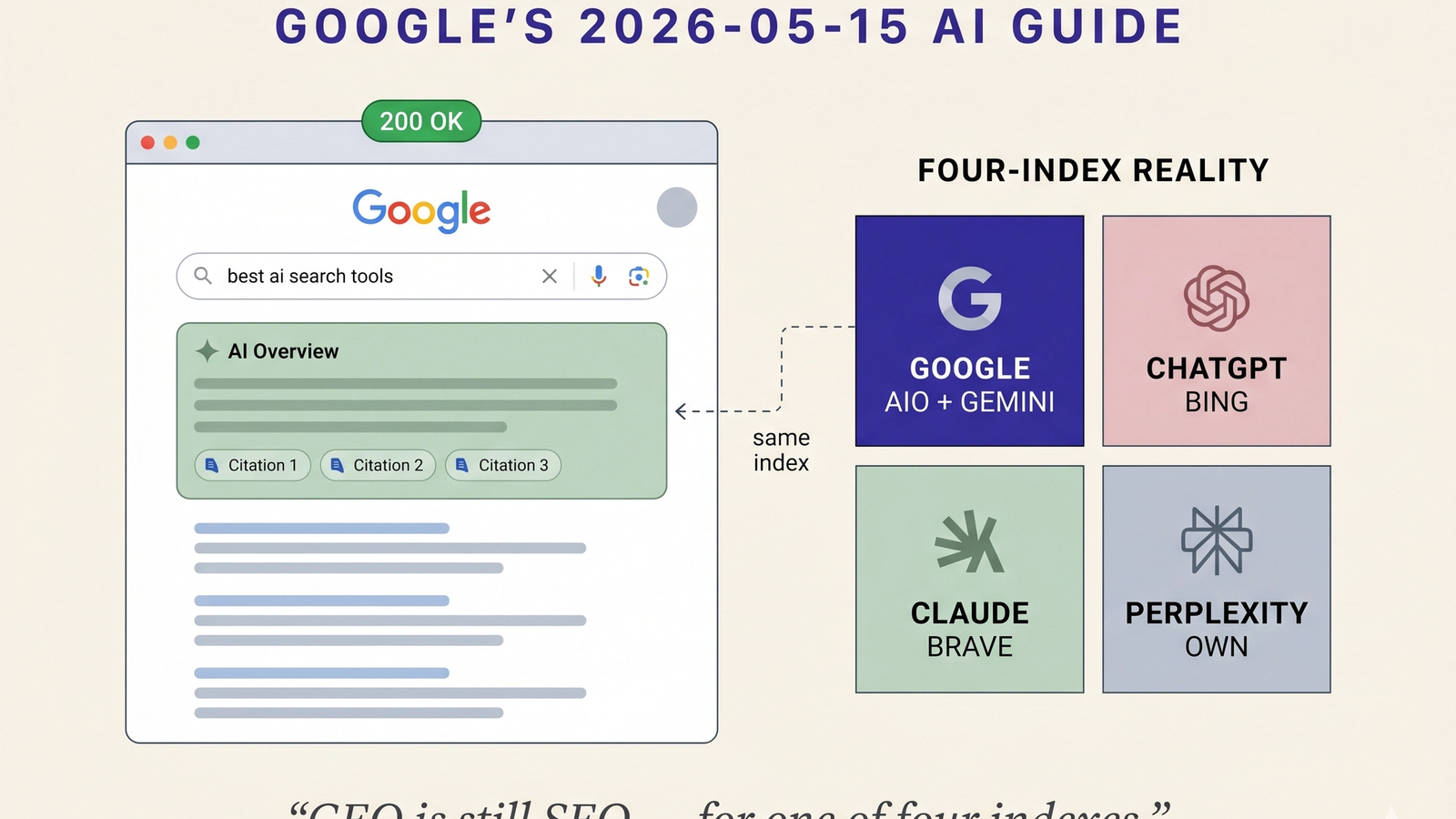
On 2026-05-15, Google published its first official guide on optimizing for generative-AI features in Search. John Mueller announced it on the Google Search Central Blog. The full document lives at developers.google.com/search/docs/fundamentals/ai-optimization-guide.
The headline claim — and it's a direct quote:
> "From Google Search's perspective, optimizing for generative AI search is optimizing for the search experience, and thus still SEO."
In the same week, Google's Gary Illyes and Cherry Prommawin told a Search Central Live audience: "GEO and AEO don't require separate frameworks."
The SEO industry's immediate reaction was framed as a debunking: Google declared generative-engine-optimization a marketing rebrand of plain old SEO. That framing isn't wrong. But it's incomplete — and the second-order conclusion that most analyses skipped is the one that matters for anyone measuring AI search:
Google just made AI Overview and Gemini tracking more important to your Google-SEO program, not less. Because if AIO is part of the Google search experience, then your AIO presence (or absence) is a leading indicator of your Google search health itself — not an adjacent KPI. The teams treating AIO measurement as an optional AI experiment are now flying blind on a meaningful chunk of their core Google traffic surface.
That's the practical thesis of this post. The rest is the work to back it up.
What Google actually said
The guide is short by Google standards — readable in fifteen minutes. The substance breaks into two lists.
What Google explicitly debunked
- llms.txt files — "You don't need to create new machine readable files, AI text files, markup, or Markdown."
- Content chunking for AI — "There's no requirement to break your content into tiny pieces for AI."
- AI-specific rewriting — "You don't need to write in a specific way just for generative AI search."
- Inauthentic "mention" building campaigns — "Seeking inauthentic 'mentions' across the web isn't as helpful as it might seem."
- Over-reliance on structured data — "Structured data isn't required for generative AI search." (Still helpful — just not load-bearing for gen-AI ranking specifically.)
What Google explicitly affirmed
- Unique, distinct-viewpoint, people-first content
- Clean technical SEO — crawlable, fast, sensible structure, good page experience
- Images and video supporting text content
- Google Business Profile + Merchant Center for local + shopping queries
- Standard Search Essentials — robots.txt, sitemaps, canonical tags, hreflang, schema.org
The most important architectural disclosure isn't a recommendation. It's this sentence:
> "AI Overviews and AI Mode … use retrieval-augmented generation and query fan-out to surface content from the Search index."
AI Overviews is now powered by Gemini 3. AIO and AI Mode read from the same Google Search index as classic blue-link results — through retrieval-augmented generation, not a separate AI-pure crawl. That single architectural fact rewires what AI search measurement is.
Why Google is right — for Google
The "GEO is still SEO" claim is true on Google. Specifically, true because:
- There is no separate Google AI index. AIO doesn't query a different corpus. RAG retrieves from the same crawled, indexed pages that fill the SERP. If the page isn't indexed, it can't be cited by AIO.
- AIO ranking inherits SERP ranking signals. Quality, authority, helpfulness, query-page semantic match — same signal stack, slightly different weighting.
- The composer is just an LLM. Gemini 3 reads what was retrieved, summarizes, and cites. It doesn't reach beyond the retrieval set.
For any team whose AI-search ambitions are Google AI specifically — AIO and AI Mode — Google's guidance is the right guidance. Follow the classic SEO playbook. Skip the AI-text-file projects. Don't pay an agency to teach you content chunking.
That's the part of the guide that should change behavior. About 60% of the "GEO checklists" published in 2024–2025 should be retired. The remaining 40% — the part that overlaps with traditional SEO — is what was always going to work.
Why ChatGPT, Claude, and Perplexity didn't disappear
Here's the leverage point most analyses missed. Google's guide only speaks for Google.
Citare's working frame for the past year has been the four-index reality: AI search isn't a single discipline because there isn't a single index behind it.
- ChatGPT grounds via Bing's index (Microsoft search infrastructure).
- Claude grounds via Brave's index (privacy-focused independent crawler).
- Gemini and Google AI Overview ground via Google's index (the one Google just officially documented).
- Perplexity runs its own crawler (PerplexityBot) feeding both training and live retrieval.
Google saying "GEO is just SEO" is Google's truth. It is not the universal truth. ChatGPT visibility tracks Bing ranking signals, not Google's. Claude visibility depends on Brave's far smaller index and very different crawl priorities. Perplexity has its own crawl cadence, its own click-through patterns, and its own dual-horizon citation logic (covered in detail at /guides/how-perplexity-indexes-websites).
Three of the four major AI search engines do not source from Google. Optimizing for them requires distinct measurement and distinct tactics — the literal opposite of what Google's guide implies if read uncritically.
What this changes for measurement
The shift in framing here is subtle but consequential. Before 2026-05-15, the case for tracking AI Overviews looked like this:
> "AI search is a new surface. Measure it because users are spending time there."
That framing was defensible but optional. Many SEO programs ignored it because the "new surface" budget didn't exist yet.
After 2026-05-15, the case is structural:
> "AIO is part of the Google search experience itself. If your Google-SEO investment is real, AIO tracking is its leading indicator. Not measuring AIO means not measuring whether your SEO is working at the surface Google now positions as primary."
That is a different sales conversation. It's the difference between "would you also like AI tracking?" and "you are currently measuring 38% of the Google SERP surface area."
For the practical work, this means three concrete changes for any team running Google SEO:
- AIO presence is a leading KPI. If a target query renders an AIO and your domain is not cited, that's a Google-SEO problem — not an AI-research-project problem.
- Gemini citation patterns are SEO signal. Gemini 3 is the AIO composer. Pages it cites in AIO are functionally the "AI-promoted top results" of the Google search experience. Track them like you track classic SERP rankings.
- Topic-by-topic measurement matters more than aggregate. AIO renders unevenly across query intents. Informational queries trigger AIO frequently; transactional queries trigger it rarely. The "% of queries with AIO" for your specific topic cluster is more useful than industry averages.
The honest take on llms.txt
This is where Citare has to be transparent about its own product surface. Citare ships an /llms-txt-guide page recommending llms.txt as a practice for AI crawlers. Google's guide explicitly says you don't need one.
That tension deserves an honest answer.
llms.txt is not dead. The standard is supported by the llmstxt.org consortium. OpenAI's GPTBot, Anthropic's ClaudeBot, and Perplexity all publish crawl behavior consistent with respecting llms.txt-style site hints. Google declined to honor the standard — which means Google won't read your llms.txt. It does not mean the rest of the AI search ecosystem won't.
The practical guidance, post-2026-05-15:
- Google-only target? Skip llms.txt. Follow Google's guide as written. Use the production engineering hours saved for actual content work.
- Multi-platform target (the four-index reality)? Ship llms.txt anyway. The cost is one static file. The benefit is non-zero for the three non-Google indexes that account for the majority of non-Google AI search traffic.
The unifying principle: what works for Google AI is a subset of what works across the four-index reality. Doing only the Google subset means optimizing for one of four indexes.
What Citare ships against this
A short, honest note on the product implications.
The "two jobs, one subscription" pitch on the Citare homepage was built before Google's announcement. It got stronger after.
Citare's Rank Tracker covers classic Google SERP — the Search Essentials foundation Google's guide reaffirms. Citare's Brand Radar covers the AIO + Gemini surface (now load-bearing for Google SEO) plus ChatGPT, Claude, and Perplexity (the three indexes Google's guide doesn't address). Both run in the same dashboard, share keyword lists, and produce a unified picture of where a brand actually appears across the search experiences customers use.
Every Ahrefs-class tool focuses on classic Google SERP and stops there. Every AI-pure tool (Profound, Otterly, Brandwatch) covers AI search and stops there. The argument for unification was always that AI search and classic SEO are converging. Google's 2026-05-15 guide is the closest thing to official confirmation that the convergence is real.
Five FAQs
Should I delete my llms.txt file because of Google's guide?
No. Google declined the standard. OpenAI, Anthropic, and Perplexity still respect it. Keep llms.txt if you care about non-Google AI search visibility. Skip it only if your strategy is Google-only.
Does Google's guide mean Brand Radar is obsolete?
No. Brand Radar measures five AI search engines. Google's guide covers two (AIO and AI Mode, both Google-powered). The three non-Google engines — ChatGPT (Bing), Claude (Brave), Perplexity (own crawler) — operate on different indexes with different ranking signals. Brand Radar is the only product that measures all five in one view.
Is structured data still worth the engineering time?
Yes, for non-gen-AI reasons. Google's guide says structured data is not required for generative AI ranking specifically. It is still required for rich results, knowledge panels, and the structured cards that account for the majority of high-CTR SERP positions. The cost-benefit is unchanged.
How does AI Overview ranking actually differ from blue-link ranking?
Same retrieval, different composition. RAG selects the candidate set from the Google index using SERP-equivalent signals. Gemini 3 then composes the AIO answer from that candidate set. The selection logic is conventional SEO; the composition logic is LLM-driven, which is why citation choice can diverge from #1 blue-link ranking even when both reference the same query.
What's the single most important change post-2026-05-15?
Stop treating AIO measurement as a separate-budget AI experiment. Treat it as a Google-SEO leading indicator. If a target query renders an AIO and you're not in it, that's a Google ranking problem worth investigating, not an AI optimization project worth deferring.
Action checklist (copy-pasteable)
For a team running Google SEO who just read Google's guide:
□ Remove llms.txt + AI-specific markdown from sprint backlog (Google-only programs).
□ Add AIO-presence as a tracked KPI for every priority query cluster.
□ Cross-check: which priority queries currently render an AIO? Which cite us? Which don't?
□ For un-cited AIO-rendering queries, audit the underlying page against Google's
  reaffirmed list: unique content, technical SEO, page experience, supporting media.
□ For sites blocking AI crawlers in robots.txt or via Cloudflare WAF, re-evaluate
  the cost — non-Google AI traffic flows through different bots than GPTBot/
  ClaudeBot/PerplexityBot. Block selectively, not categorically.
□ Update internal SEO reporting templates: AIO citation column alongside SERP
  rank column. Different signals, same dashboard.
For a team running multi-platform AI visibility (the four-index target):
□ Keep llms.txt. Cost is negligible; benefit applies to 3 of 4 major engines.
□ Treat Google's guide as Google's guide. Apply it to AIO + Gemini measurement
  only. Don't extrapolate to ChatGPT (Bing), Claude (Brave), or Perplexity (own).
□ Run per-platform crawl audits — bot UA detection across all five engines.
  GPTBot blocked at Cloudflare ≠ AIO will see you (AIO uses Googlebot).
□ Maintain a single dashboard that shows where the brand surfaces across all
  five platforms. Cross-platform diff is more actionable than per-platform deep
  dives.
Closing
Google's 2026-05-15 guide is the most useful industry document of the year so far. The "GEO is still SEO" framing is correct for Google and correct in the direction it points the field — back toward foundations. The work that always mattered still matters.
What changes is not the work. What changes is what tracking that work looks like. AI Overview presence is now part of Google SEO measurement, not adjacent to it. Anyone running a Google-SEO program who treats AIO as optional is now measuring the wrong surface area.
The four-index reality didn't go anywhere. It got more important to be honest about which index you're optimizing for, because Google just clarified one of the four. The other three remain the same hard problem they were on May 14.