Tracking brand mentions across ChatGPT, AIO, Gemini, Claude, Perplexity — what each platform reveals
ChatGPT, AIO, Gemini, Claude, Perplexity each draw from a different index. What each reveals, and why ChatGPT-only monitoring fails.
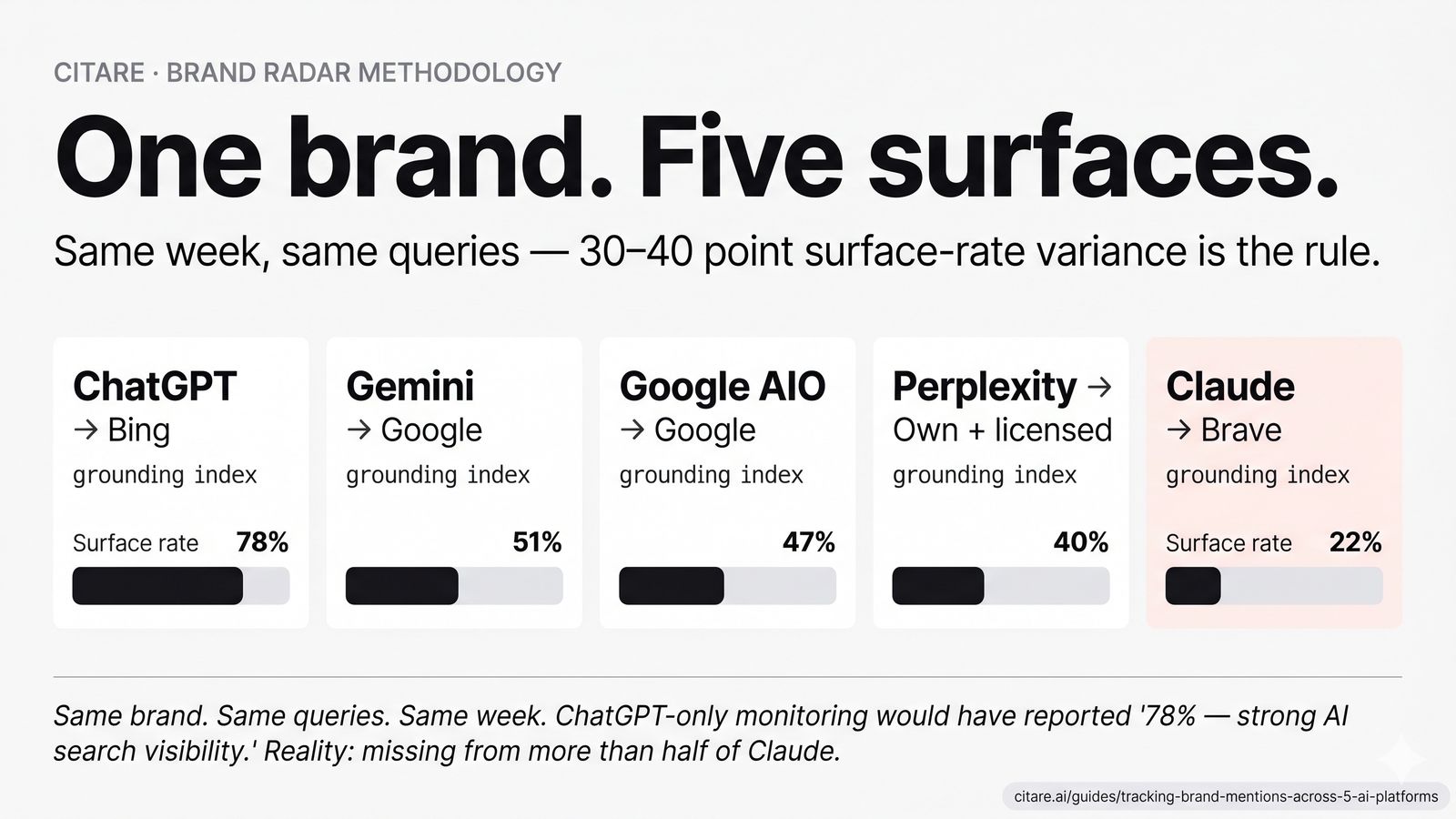
The five major AI search platforms — ChatGPT, Google AI Overview, Gemini, Claude, Perplexity — each draw from a different underlying index, weight that index differently, and synthesize answers using different model families. On any given week, the same brand will surface on different fractions of queries on each platform. We have run identical query batches through all five for months; the surface-rate variance between the strongest and weakest platform routinely lands at 30-40 percentage points for the same brand in the same week.
This is the four-index reality at work. It also means that monitoring one platform — typically ChatGPT, because it's the most-discussed — produces a misleading picture of where your brand actually stands in AI search. This guide breaks down what each of the five platforms reveals, where each one systematically blind-spots, and the operating discipline that comes out of measuring all five in parallel.
The five platforms at a glance
- **ChatGPT search** — Grounding index: Bing · Citation exposure: URLs visible in DOM citations + footnotes · Surface character: Highest surface rate; longest answer bodies; most generous mention lists
- **Google AI Overview** — Grounding index: Google · Citation exposure: URLs visible as citation chips; not always in DOM · Surface character: Highly dependent on structured-data signals; favors third-party comparison pages
- **Gemini** — Grounding index: Google + Google Search grounding · Citation exposure: Inconsistent citation exposure · Surface character: Process/HowTo bias; uses step-by-step framing more than the other four
- **Claude (web search)** — Grounding index: Brave · Citation exposure: Sparse citations; rarely names exact URLs · Surface character: Most conservative; lowest surface rate; highest avg position when present
- **Perplexity** — Grounding index: Own crawl + licensed index · Citation exposure: Citation URLs always exposed · Surface character: Strongest first-party-page bias; favors brand homepages and direct documentation
The cells in this table are not interchangeable. A brand pulling 95% surface rate on ChatGPT is not "winning AI search" if the same brand is at 40% on Claude and 50% on Perplexity. Worse — the playbook to lift each platform is different. There is no single content investment that lifts all five at once. The platforms ground in different indices, weight content differently, and have categorically different citation behaviors.
What ChatGPT search reveals
ChatGPT search grounds in the Bing index, which means the underlying retrieval pool overlaps significantly with classic Bing SERPs. Brands that have invested in Bing webmaster signals, schema.org markup, and broad-link comparison content typically surface well here. ChatGPT also produces the longest answer bodies of the five platforms and the most generous brand-mention lists — a query that returns three brands on Claude often returns six or seven on ChatGPT. Citation rate is consequently inflated on ChatGPT relative to the other four; share of voice is correspondingly diluted.
What ChatGPT reveals well: breadth of category presence. If you surface across multiple query phrasings on ChatGPT, that's a strong signal that your content has broad topical authority across the related JTBDs.
What ChatGPT under-reveals: depth of authority. Because ChatGPT lists many brands, being mentioned is a low bar; being mentioned at position #1 is the higher signal. Track top-recommended rate specifically on ChatGPT, not just surface rate.
What Google AI Overview reveals
AIO grounds in the Google index and synthesizes responses using Gemini. The selection mechanism that decides which pages get cited in the AIO panel is not the same as the algorithm that ranks the blue links beneath it — we have measured cases where a page sits at position #4 in the blue-link list but is the only page cited in AIO, and vice versa. AIO favors pages with strong structured-data signals (FAQPage, HowTo, Article schemas), explicit JTBD phrasing in H1/H2, and quotable definitional sentences in the first paragraph.
What AIO reveals well: content that meets Google's "citeable authority" bar. If you surface in AIO, your content is structured well enough to be quoted directly — a signal worth treating as a content-quality validation.
What AIO under-reveals: anything not in Google's web index. A brand with strong presence on Reddit, X, or LinkedIn but a thin first-party website may surface heavily on other platforms but be absent from AIO entirely.
Specific to AIO: track DOM citations separately from the answer body. AIO sometimes mentions a brand in the answer body but doesn't surface a citation chip; other times it surfaces a citation chip from a brand's page even when the brand isn't named in the body. Both signals matter; both are tracked separately in Brand Radar.
What Gemini reveals
Gemini also grounds in the Google index but uses a different retrieval pipeline than AIO — and the response style is markedly different. Gemini responses tend to be process-shaped ("Step 1, Step 2, Step 3") and favor pages with HowTo or step-by-step structure. In the Notion audit, the only platform where Notion lost on its strongest JTBD (50-person company wiki, Q10) was Gemini — which placed Notion at position #2 behind Confluence. The mechanism: Confluence's product page is structured as a process blueprint with explicit step framing; Notion's page is a feature-led marketing page.
What Gemini reveals well: whether your content is process-friendly. A brand that surfaces on Gemini for category queries usually has at least one page that reads as a procedural walkthrough.
What Gemini under-reveals: brand positioning on opinion-shaped queries. Gemini hedges more than the other four platforms; on "best X for Y" queries it often returns balanced framings ("the right choice depends on...") where ChatGPT or Perplexity would name a single brand.
What Claude (web search) reveals
Claude grounds in the Brave index, which is the smallest of the four indices and has a different content-discovery pattern than Google or Bing. Brave indexes the open web aggressively but underweights large-platform aggregations (Reddit, Medium archive, listicle pages). This shows up in the data as Claude having the lowest surface rate of the five platforms — but the highest average citation position when present. When Claude does name a brand, it usually names it first.
What Claude reveals well: topical authority on the brand's own domain. If Claude surfaces you, that's typically because your own first-party content (homepage, product pages, documentation, blog) is strong enough to register against Brave's leaner index.
What Claude under-reveals: third-party-driven visibility. A brand whose presence is largely through listicle mentions and review-aggregator pages will surface heavily on ChatGPT but be absent from Claude.
Practical implication: if Claude is your weakest platform, the content investment is on your own domain — pillar pages, comparison pages, JTBD-phrased landing pages — not on outbound link-building or third-party content.
What Perplexity reveals
Perplexity maintains its own index built from a hybrid of public-web crawl and licensed data sources. The platform exposes citations on every answer — typically 4-8 source URLs per response — and is the most transparent of the five on the question "which pages did the model read to produce this answer." Perplexity favors first-party pages (brand homepages, product documentation, blog posts on the brand's own domain) over third-party aggregations.
What Perplexity reveals well: which of your own pages are the canonical source for a given query. The citation URL list on a Perplexity answer is effectively a per-query ranking of which of your pages the platform considers most authoritative.
What Perplexity under-reveals: category breadth. Because Perplexity's answers are shorter and cite fewer brands per query than ChatGPT, surface rate on Perplexity tends to run 10-15 points lower than ChatGPT for the same brand — that's a model behavior, not a visibility gap.
The "monitor only ChatGPT" trap
Several point tools in the AI search monitoring category cover only ChatGPT — typically because ChatGPT was the first platform with broad measurement infrastructure and the platform with the largest user-base PR attention. The trap: ChatGPT is the most generous surface of the five, so any brand with even moderate category presence will look fine on ChatGPT.
Real example from a recent customer audit (anonymized): the brand ran ChatGPT-only monitoring for three months, reported 78% surface rate, and concluded their AI search visibility was strong. We ran the same query batch against all five platforms and the splits were:
- ChatGPT — Surface rate (same brand, same queries): 78%
- Gemini — Surface rate (same brand, same queries): 51%
- Google AIO — Surface rate (same brand, same queries): 47%
- Perplexity — Surface rate (same brand, same queries): 40%
- Claude — Surface rate (same brand, same queries): 22%
The brand was missing from more than half of the Claude responses and a clear majority of Perplexity responses. The single-platform read was correct as far as it went — it just wasn't measuring most of the picture. The investment that lifted Claude from 22% to 58% over the next 6 weeks was a complete rewrite of the brand's pillar page using the JTBD phrasings we surfaced from the gap analysis. ChatGPT moved 3 points in the same period — already saturated.
What changes per platform when you ship content
Different content investments move different platforms. The empirical pattern, from running before/after measurements on dozens of pages:
- Comparison "X vs Y" pages with named competitors — Strongest platform response: ChatGPT, Perplexity · Weakest platform response: Gemini (often unchanged)
- FAQPage schema added to existing pages — Strongest platform response: Google AIO, Gemini · Weakest platform response: Claude (Brave underweights schema)
- HowTo schema with step-by-step structure — Strongest platform response: Gemini · Weakest platform response: ChatGPT (unchanged)
- First-party landing pages with explicit JTBD H1 — Strongest platform response: Claude, Perplexity · Weakest platform response: ChatGPT (already saturated)
- Third-party comparison pages / guest posts — Strongest platform response: ChatGPT, Google AIO · Weakest platform response: Claude, Perplexity
- Reddit + community thread participation — Strongest platform response: ChatGPT (Bing indexes Reddit deeply) · Weakest platform response: Claude (Brave skips Reddit)
- Press hits / news mentions — Strongest platform response: ChatGPT (short-term spike) · Weakest platform response: Claude (no effect)
The asymmetry means a content roadmap built without a five-platform read is essentially blind to which investment closes which gap. A brand that's strong on ChatGPT and weak on Claude doesn't need more comparison content — it needs more first-party JTBD pages. A brand that's strong on Claude and weak on Gemini doesn't need more pillar pages — it needs HowTo schema on the ones it already has.
How to measure all five in parallel
The mechanical answer: a 5-platform dispatch instrument that captures the full response from each platform in the same week, on the same queries, with the same anti-prime discipline. This is what Citare Brand Radar does — the methodology guide walks through the five-stage pipeline and the platform-specific capture techniques (Playwright DOM for four platforms, Haiku-vision-on-screenshot for AIO).
The conceptual answer: never read a single-platform number in isolation. Every metric — surface rate, top-recommended rate, average position, share of voice — should be reported per platform alongside the cross-platform weighted average. The weighted average is useful for the topline summary; the per-platform splits are where the actual diagnostic signal lives.
A starter Brand Radar run with 10 queries × 5 platforms = 50 cells per week. Tiered cell counts (50, 75, 100) reflect category complexity — niche categories need more cells to differentiate noise from signal.
Frequently asked
Why not just monitor the AI platforms that send the most traffic? Two reasons. First, traffic numbers measure where users click through; the AI panel itself absorbs significant query intent that never produces a click. Second, visibility on the platforms that send less traffic today is the leading indicator of where the long-term shift lands — Claude grew 3× year-over-year in our analytics samples even though its absolute traffic share is still small. Measuring all five today is how you avoid waking up to a category where you're invisible on the platform that just won.
Which platform exposes the most reliable citation data? Perplexity, then ChatGPT search, then Google AIO. Claude and Gemini both expose citations inconsistently — the DOM doesn't always carry them and the answer text rarely names exact URLs. Brand Radar reports DOM citations separately from answer-body brand mentions specifically because the two signals diverge on Claude and Gemini.
Can I just ask one of the AI models which brands it surfaces? Asking ChatGPT or Claude directly is unreliable. Models have very poor introspection about their own surfacing behavior — they will confidently produce answers that don't match their actual behavior on the same query 5 minutes later, especially when the question is "which brands do you usually recommend." The only reliable measurement is observational: run the query, capture the actual response, parse the actual mentions.
How long does it take a new page to surface in AI search? Median time-to-surface across the five platforms is 4-8 weeks for new pages on established brand domains; 12-16 weeks for net-new domains. ChatGPT typically surfaces new content fastest (Bing's index refresh cadence is aggressive); Claude is slowest because Brave's index update cadence is the slowest of the four. Perplexity surfaces new content faster than Claude but slower than ChatGPT.
Does adding llms.txt change anything? Modestly. OpenAI, Anthropic, and Perplexity respect llms.txt directives for training-data scoping; Google has formally declined to participate in the standard. The actual surface-rate impact is small in our measurements — typically <2 percentage points within the first 8 weeks of publishing — but the long-tail effect on response framing (correct product names, correct positioning language) is meaningful. See the honest llms.txt guide for the per-platform behavior.
Ready to baseline all five platforms?
Free forever tier covers one project with weekly 5-platform dispatch — same shape we publish the famous-name audits with. Onboarding takes ~10 minutes; first run completes in 90 minutes; weekly trend builds from there.
→ Read the Brand Radar methodology for the full 5-stage pipeline
→ Understand citation rate vs share of voice — both metrics reported per platform
→ See the published Notion audit — 5-platform breakdown across 75 cells