Brand Radar for Indian D2C — measuring AI search visibility from India
Indian D2C brands face a measurement gap in AI search. How to measure visibility across all 5 AI platforms from India — methodology + playbook.
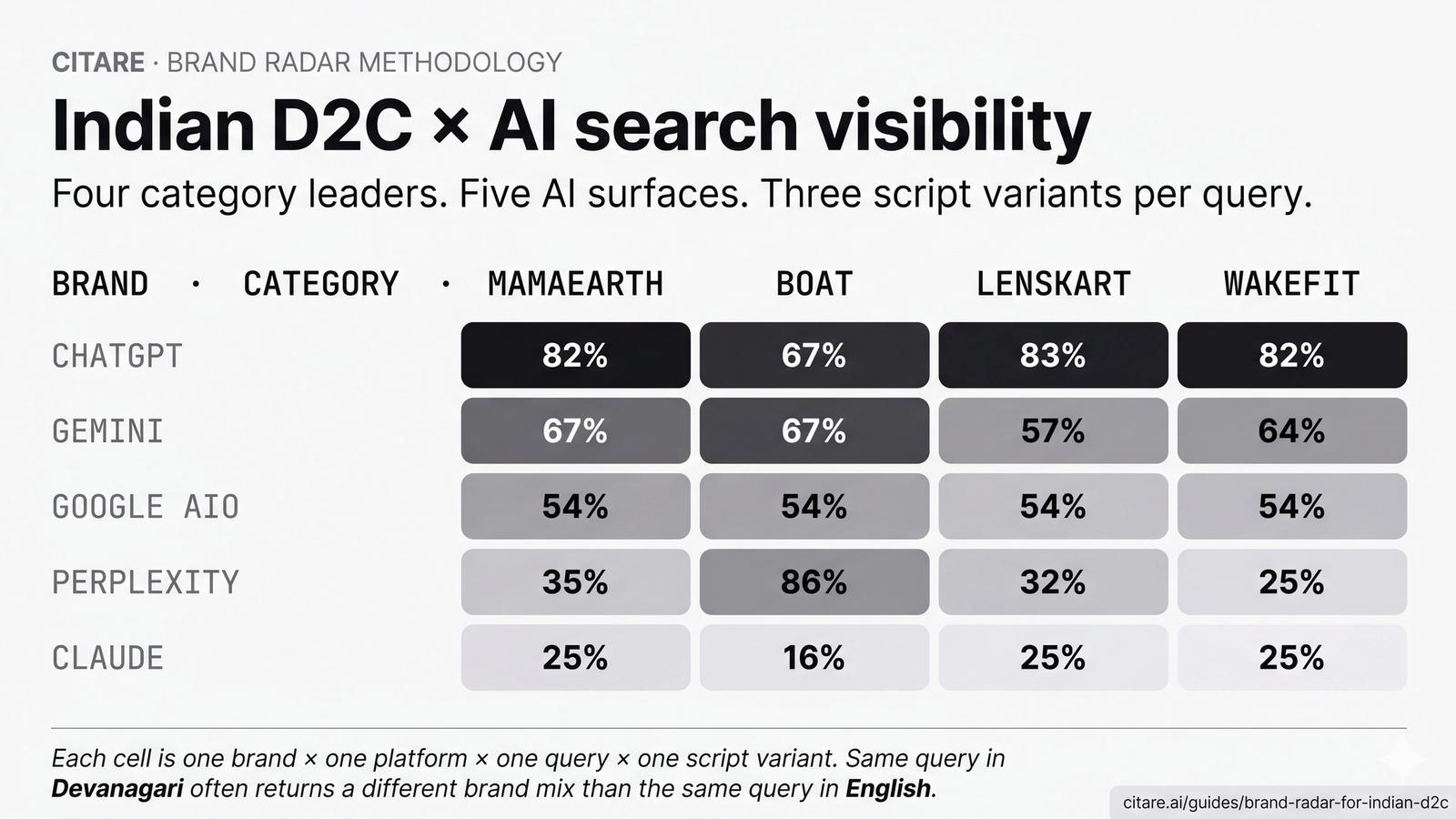
Indian D2C is the fastest-growing consumer-brand market in the world and the most under-measured surface in AI search. The major Indian D2C category leaders — Mamaearth in personal care, BoAt in audio, Lenskart in eyewear, Wakefit in mattresses — have built textbook content moats on classic Google SERPs. The same brands' visibility on the five AI search platforms is uncharted, and the early measurement we've done suggests the answers don't match the SERP rankings closely.
This guide explains what Brand Radar measures for an Indian D2C brand, how the five platforms behave differently on India-targeting queries, the regional sourcing biases each platform carries, and the operating playbook for measuring AI search visibility from India.
Why Indian D2C measurement is different
Three structural realities make AI search measurement from India different from US/EU measurement.
Underlying indices weight India-targeting content unevenly. Bing's India index is the weakest of the four major underlying indices for Indian content; it under-indexes Indian D2C category pages relative to Google or Perplexity's own crawl. Brave (which Claude grounds in) is similarly under-indexed for Indian content but with different gaps. Perplexity's licensed-data partnerships skew toward US/UK publishers. Google's own index is the strongest for Indian content because the SERP business in India is mature — but AIO behavior in India is still settling and the panel composition varies week-to-week more than US AIO.
The persona language is different. A category query phrased "best face wash for oily skin" returns different brands from a query phrased "ഏറ്റവും നല്ല face wash" (Malayalam) or "तेलीय त्वचा के लिए face wash" (Hindi) — and the brand mix on each language version of the same query is platform-dependent. ChatGPT handles Hindi-script queries adequately on category mentions but loses brand-specific framing; Gemini handles Devanagari + transliterated Hindi well; Claude's web search handles transliterated Hindi better than Devanagari. Perplexity returns nearly identical brand lists across script variants.
Indian D2C category structure has more sub-categories than US/EU equivalents. "Best toothpaste in India" is a categorically different query from "best toothpaste for kids in India" — and Indian platforms split sub-categories more aggressively than US comparables. A measurement instrument that doesn't decompose the category into sub-categories misses real surface-rate variance.
What Brand Radar measures for an Indian D2C brand
A standard Brand Radar dispatch for an Indian D2C brand: 10-15 queries across 3-4 personas, all 5 platforms, weekly. The five metrics — surface rate, top-recommended rate, average position, share of voice, competitor delta — are computed per platform. For India-specific runs, the standard mix adapts:
- Category (anti-prime) — Standard mix: 30% · India adaptation: 30% — split across Hindi-script, transliterated-Hindi, English variants
- Comparison vs named competitors — Standard mix: 25% · India adaptation: 25% — includes both Indian D2C competitors AND legacy MNC equivalents (e.g. Mamaearth vs HUL, BoAt vs Sony)
- Branded — Standard mix: 20% · India adaptation: 20% — same
- Job-to-be-done — Standard mix: 25% · India adaptation: 25% — phrased in the customer's natural script + JTBD specifics ("which X is good for monsoon-season skin")
Personas adapt too. The standard library includes India-specific personas (India-SMB, India-D2C-founder, urban-Indian-millennial, tier-2-tier-3-buyer) layered with brand-specific personas the founder adds during the Query Guide edit phase. The point is to surface the queries Indian customers actually ask in the language they actually ask them — not to dispatch US-style English category queries.
What each platform reveals about Indian brands
The patterns we've observed in early Indian D2C measurement work:
ChatGPT search surfaces large-volume India D2C brands well on English category queries but loses competitor depth on Hindi-script variants. Surface rates of 70-85% are common for the top 3 brands in a category; the bottom 5-10 brands in the same category often surface at <20%. ChatGPT's tendency to list 6-8 brands per answer means category-share-of-voice is heavily diluted in Indian categories.
Google AIO in India is the most volatile of the five platforms. We have seen the same query return entirely different AIO panel compositions week-over-week for the same brand. Structured data investments (FAQPage, Product schema, Review schema) move AIO surface rates faster in India than the other platforms — partly because the underlying Google SERP rewards structured data heavily for India-targeting content. Brands that have invested in Product + Review schema typically out-perform their classic SERP rank in AIO.
Gemini favors India-specific sources — India.gov.in, NCERT-adjacent content, established Indian publishers (LiveMint, ET, Inc42, YourStory). For Indian D2C brands, Gemini's surface character is more "named-publication-driven" than the other platforms. A Mamaearth featured in an Inc42 article surfaces more reliably on Gemini than the same brand featured in a TechCrunch article — even if the absolute reach is similar.
Claude has the smallest absolute presence in India today. Surface rates run 15-25 percentage points lower than ChatGPT for the same Indian D2C brand. The mechanism: Brave's Indian crawl is shallower than Bing's, and Claude's web search depends on what Brave indexes. Claude's strength elsewhere — surfacing brands with strong first-party content — applies in India too, but the base rate is lower.
Perplexity treats Indian brands the most consistently across script variants. Surface rates on Hindi-script, transliterated, and English versions of the same query land within 5 points of each other for established Indian D2C brands. Perplexity's first-party-page bias means a brand's own .com or .in page is the most-cited source on branded queries — which is the easiest of the five platforms to influence with content investment.
The four-week Indian D2C audit pipeline
Per the Phase 13 launch plan, our weeks 5-8 famous-name audit pipeline is locked on four Indian D2C category leaders. Each audit will run with India-specific personas + query mix and publish at /audits/<brand-slug> the Friday of that week.
- 5 — Brand: Mamaearth · Category: Personal care / beauty · Why this brand: Largest Indian D2C unicorn; LinkedIn-active founders; baseline for category
- 6 — Brand: BoAt · Category: Audio / wearables · Why this brand: Strong direct-channel content; comparable to Anker for US audits
- 7 — Brand: Lenskart · Category: Eyewear / health · Why this brand: Public company; long content tail; comparable category leader to Warby Parker
- 8 — Brand: Wakefit · Category: Mattresses / home · Why this brand: Strong topic-cluster content strategy; tier-2/3 city presence stronger than urban-only D2C
Each audit will publish surface rate per platform, top-recommended rate per platform, competitor delta (including legacy MNC competitors where relevant), and a script-variance breakdown showing how Hindi-script and transliterated-Hindi versions of the same query produce different brand mixes. Methodology will be reproducible against preserved Brand Radar artifacts — same standard we held the Notion audit to.
The script-variance dimension — why one language isn't enough
The most under-measured signal in Indian D2C AI search is script-variance. A category like "best moisturizer for oily skin in India" has at minimum three meaningful phrasings:
- English — "best moisturizer for oily skin in India"
- Transliterated Hindi — "oily skin ke liye best moisturizer"
- Devanagari — "तेलीय त्वचा के लिए सबसे अच्छा मॉइस्चराइज़र"
Each phrasing returns a different brand mix on each platform. Mamaearth might top the English variant on ChatGPT but rank #4 on the Devanagari variant. The competitor at #1 on Devanagari might be an Ayurvedic brand that doesn't surface on the English variant at all. A monitoring approach that only runs the English version is measuring less than a third of the actual visibility surface.
Brand Radar runs all three script variants in parallel for India-targeting queries when the brand's customer base spans tier-1 + tier-2/3 markets. The script-variance breakdown is the most operationally useful single output of an India dispatch — it directly tells the content team which language variants need parallel landing pages.
What playbook moves Indian D2C surface rates
The empirical pattern from before/after measurements on Indian brand content:
- Product schema + Review schema on category pages — Strongest platform response: Google AIO, Gemini · Time-to-effect: 2-4 weeks
- Named-publication PR (Inc42, YourStory, ET) — Strongest platform response: Gemini, Perplexity · Time-to-effect: 4-8 weeks
- Hindi-script + transliterated landing pages — Strongest platform response: All 5 platforms on script-variant queries · Time-to-effect: 4-6 weeks for new pages
- First-party JTBD pages targeting "X for monsoon," "X for tier-2 city," etc. — Strongest platform response: Claude, Perplexity · Time-to-effect: 6-10 weeks
- Wikipedia + Wikidata presence — Strongest platform response: All 5 platforms (most on Gemini, ChatGPT) · Time-to-effect: 8-16 weeks
- Reddit / r/IndiaInvestments / r/IndianFood comment depth — Strongest platform response: ChatGPT (Bing indexes Reddit deeply) · Time-to-effect: 2-4 weeks
The single highest-leverage Indian-specific investment is Hindi-script landing pages — the platform-agnostic surface lift averages 12-18 percentage points within 6 weeks for brands that haven't yet shipped them. Most Indian D2C brands haven't shipped them; the brands that have are usually those with operations teams who already maintain Hindi-script support content for customer service.
How this connects to the India hub
The Citare /india hub is the marketing-side counterpart to this measurement-side guide. The hub covers the strategic and commercial case for India-targeting AI search and SEO; this guide covers the operational instrument. They reference each other intentionally — read in either order.
Concrete next steps for an Indian D2C brand exploring measurement:
- Run a one-week 50-cell Brand Radar dispatch covering the brand's top 3 category queries × 3 personas × 5 platforms × 3 script variants. Free tier; no commitment.
- Read the per-platform breakdown alongside the citation rate vs share of voice guide — both metrics matter, both behave differently in India.
- Decide content investments based on the gap pattern. If Hindi-script variants under-surface, ship Hindi-script landing pages. If Gemini lags AIO, invest in named-publication PR.
- Re-measure at week 6 to confirm the investment moved the right platforms.
Frequently asked
Does Brand Radar measure regional Indian languages beyond Hindi? Yes — Tamil, Telugu, Bengali, Marathi, Kannada, Malayalam, Gujarati, Punjabi script variants are all supported on the dispatch instrument. The standard India persona library includes a "regional-language buyer" persona that can be configured per brand. Most Indian D2C measurement work in 2026 still runs primarily English + Hindi-script + transliterated-Hindi; full regional language coverage matters most for brands with strong tier-2/3 city presence.
How does Citare price Brand Radar for Indian brands? INR pricing (shown when accessed from India IPs) — Free tier is the same shape as the global free tier. Pulse ₹2,999/mo, Pro ₹9,999/mo, Agency ₹24,999/mo, Enterprise ₹99,999+/mo. See the India pricing page for the full breakdown.
Will the four-week audit pipeline cover brands beyond Mamaearth/BoAt/Lenskart/Wakefit? Yes — those four are the publication-ordered launch sequence; brands suggested via /contact or LinkedIn engagement are added to the pipeline weekly thereafter. The Citare /audits hub will continue weekly publication indefinitely.
How does AI search visibility translate to revenue for an Indian D2C brand? The leading-indicator pattern we've measured: 1 percentage-point surface-rate gain on category queries correlates to ~0.5-1.5% increase in direct-channel session volume over the following 6-10 weeks, with significant variance by category. The correlation is strongest for high-consideration categories (mattresses, eyewear, prescription products) and weakest for impulse categories (snacks, accessories). This data is preliminary; we'll publish a quantitative correlation study in a future research drop once the dataset is large enough.
What's the cheapest first measurement for a brand with no prior data? The Free tier 50-cell weekly dispatch — covers 10 queries × 5 platforms with 3-4 personas. Surface rate + top-recommended rate per platform; competitor delta against up to 5 named competitors. Free forever; no card required for sign-up.
Ready to baseline your Indian D2C brand?
→ Start free with one project — INR pricing shown automatically from India IPs
→ Read the Brand Radar methodology for the underlying 5-stage pipeline
→ See the published Notion audit — same methodology applied end-to-end
→ Browse the India hub for the strategic + commercial side of India-targeting AI search