GEO for D2C Brands: AI Visibility for Consumer Brands
D2C brands face the PNG-content problem — visual differentiation invisible to AI. The five-stage D2C GEO playbook with real audit data.
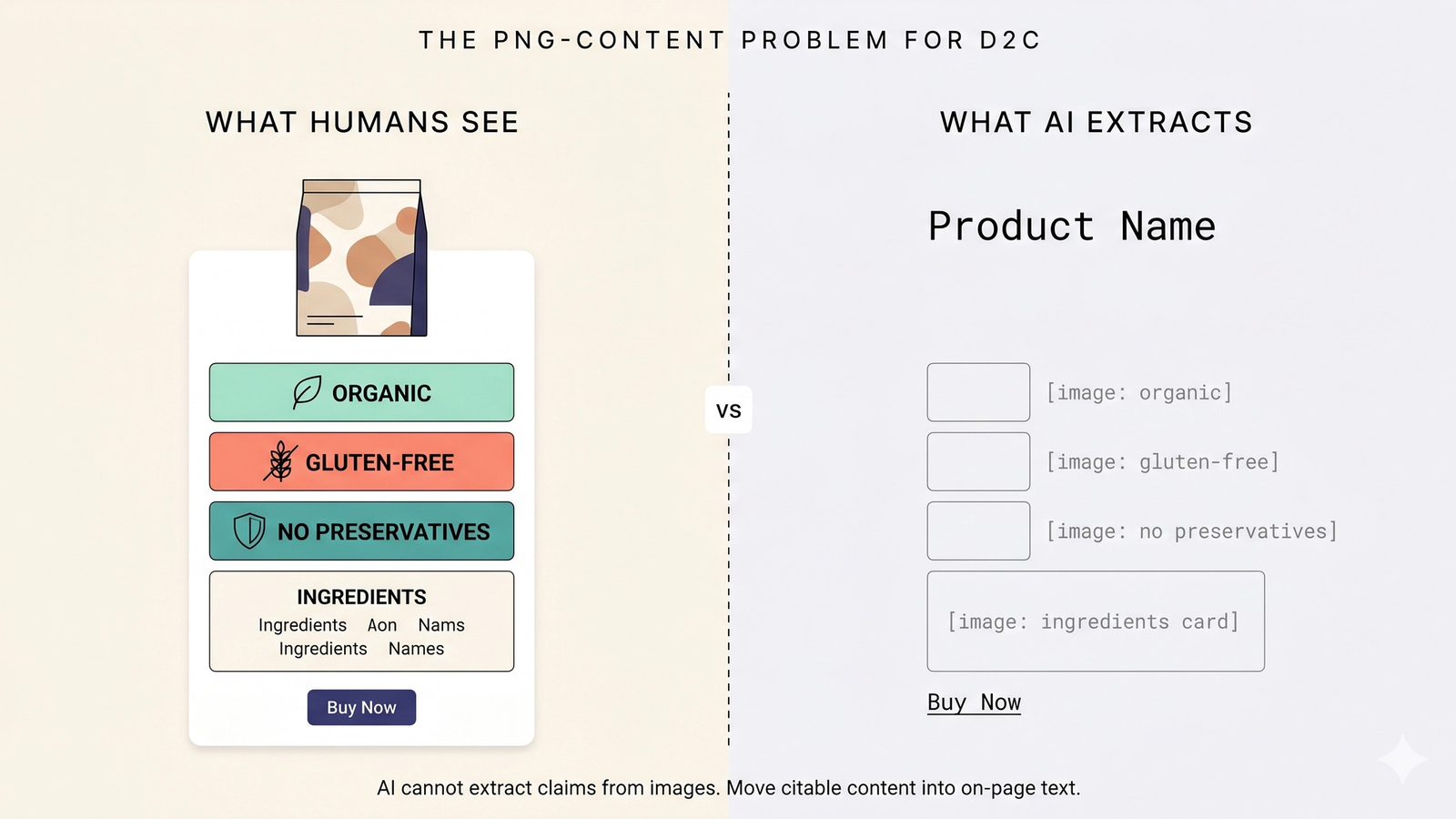
D2C brands face the most acute structural mismatch between traditional brand-building patterns and GEO realities.
The visual identity D2C teams obsess over — beautiful PNG product cards, aspirational image-led storytelling, certification badges, ingredient panels rendered as images, lifestyle photography — is exactly the surface AI platforms cannot extract. The content humans see is not the content AI cites.
In a brand audit we ran of a funded D2C food brand in India — top-3 Google ranking, multi-year SEO investment, strong organic traffic — the brand surfaced in just 1.8% of 300 AI search queries across five personas and three platforms. Not because the brand was weak. Because the brand's differentiation lived in image cards that AI couldn't see.
This guide is the D2C-specific GEO playbook: why consumer brands face structurally distinct AI search problems, the PNG-content problem in detail, the five-stage execution plan, and how comparison-shopping AI queries are becoming the new D2C top-of-funnel. The conceptual context is in What is Generative Engine Optimization (GEO)?. For India-specific D2C realities, see also GEO for Indian Brands.
Why D2C Is Structurally Distinct on GEO
Four characteristics make D2C GEO economics different from B2B SaaS, professional services, or local services.
Image-led brand identity
D2C brand differentiation lives in visual design. Packaging photography. Lifestyle imagery. Hand-drawn illustrations of ingredients. Beautifully designed PNG cards listing organic certifications, sustainability claims, and quality differentiators. The visual identity is the brand's competitive moat — and it's invisible to AI extraction at citation time.
A brand investing heavily in design while not investing in HTML-text equivalents has built moats that humans can see and AI cannot.
Comparison-shopping is the AI use case
For D2C, the highest-intent AI queries are comparison-shopping queries: "best organic baby food brand in India", "top clean-label snack brands", "healthiest cereal alternatives". These are purchase-intent queries that used to be Google searches and are increasingly happening on ChatGPT, Gemini, and Perplexity.
When AI platforms answer these queries, they cite specific brands. The brands cited enter the consideration set. The brands absent don't get the discovery moment.
Ingredient and certification claims drive evaluation
D2C buyers — particularly in food, supplements, beauty, baby — evaluate based on specific claims: ingredients, certifications, sourcing, sustainability. These claims are typically rendered as image cards on product pages because that's how D2C teams visualize them.
If the claim "USDA Organic certified" exists only as an image on the product page, AI cannot cite it as a differentiator. The brand competes on AI surfaces with one hand tied — the differentiating claims are real but extractable only by humans.
Geo-aware AIO citation
D2C is geographic. Delivery zones. Store presence. Shipping availability. Same query — "best organic snack brand" — produces different citations from Bangalore vs Delhi vs Mumbai. AIO is geo-aware and weights local signals heavily.
D2C brands with strong national presence but weak per-city structured data drop out of city-level AIO. Multi-city D2C brands particularly need geo-specific landing pages, not collapsed homepages.
The PNG-Content Problem in Detail
In our audit of a D2C grocery brand (anonymized): the brand's ingredient certifications, organic sourcing claims, and quality differentiators were all rendered as PNG image cards on the product page.
What humans saw on a product page:
- Beautiful packaging photography
- A "100% Organic" badge as a colored image card
- A "Sourced from [region]" graphic with a map illustration
- An ingredients list rendered as a styled visual card
- "Free from [10 ingredients]" claim panel as graphic design
- Customer testimonial cards with photos
What AI extracted from the same page:
- The product name in HTML text
- A short HTML description (4 lines of text)
- The price (from the JSON-LD Product schema)
- A few links to other pages
- That was it.
Result: 300 AI queries × 5 personas × 3 platforms = 1.8% surface rate. The brand had Google's top-3 ranking. AI Overview had the brand indexed. ChatGPT could find the brand on Bing. None of them had anything substantive to cite about WHY the brand was differentiated, because the answer was locked in PNGs.
The fix is not aesthetic. The fix is technical: HTML-text equivalents on the page alongside the visual design. Keep the badges. Keep the photography. Keep the visual identity. Add the equivalent text content in the page's HTML so AI can extract the claim.
A "USDA Organic" badge image stays. Below or alongside it: an HTML paragraph stating "USDA certified organic — independently verified." The visual experience for humans doesn't change. The extractable content for AI changes from nothing to something.
The D2C GEO Playbook — Five Stages
Sequenced for maximum citation impact in 90-180 days.
Stage 1: Foundation (Weeks 1-2)
Same as every brand:
- Allow Google-Extended, GPTBot, ClaudeBot, PerplexityBot in robots.txt (AI Crawler Access Guide)
- Submit sitemap to Bing Webmaster Tools (closes the ChatGPT visibility gap)
- Deploy Organization JSON-LD with full sameAs array (LinkedIn, Crunchbase, Instagram, Trustpilot, Amazon storefront if applicable)
Time: 1-2 days. Effect: 4-8 weeks for measurable lift.
Stage 2: Content Extraction (Weeks 2-6)
The D2C-specific stage. Move every brand claim, certification, ingredient, and differentiator out of image cards into on-page HTML text.
Audit checklist per product page:
- All certifications (organic, gluten-free, vegan, fair-trade, USDA, etc.) — visible image badges PLUS HTML text declaring them
- Ingredient lists — visual card PLUS HTML structured list
- Sourcing claims ("Made in [region]", "Sourced from [origin]") — graphic PLUS HTML paragraph
- "Free from" panels — visual PLUS HTML allergen / exclusion list
- Quality differentiators — image-led storytelling PLUS HTML descriptive paragraph
Keep everything visual. Add HTML text alongside.
This is the highest-leverage D2C-specific intervention. Most D2C audits we run reveal 60-80% of differentiating content is image-locked. Extracting that into HTML produces measurable surface rate lift within 4-8 weeks.
Stage 3: Product Schema (Weeks 4-6)
Comprehensive Product JSON-LD on every product page. (See Structured Data and JSON-LD for AI Search for the full code samples.)
D2C-specific Product schema must-haves:
name,description,brand,sku,gtin(Global Trade Item Number)imagearray with multiple product photosofferswithprice,priceCurrency,availability,priceValidUntilaggregateRatingand individualReviewitems (cross-references to Trustpilot, Amazon, Google reviews where applicable)additionalPropertyfor ingredients, certifications, sourcing claims (this is where you encode the extracted-from-images content as structured data)
For food and beverage D2C, also consider Recipe schema on relevant content pages — high-leverage for cooking and meal-planning AI queries.
Stage 4: Comparison Content (Weeks 6-12)
Comparison-shopping queries are the new D2C top-of-funnel. Build pages that explicitly target them:
- "Best [category] in [geography]" pages — "best organic baby food in India", "best clean-label snacks in Bangalore"
- "[Your brand] vs [competitor]" pages
- "[Category] brand comparison" — multi-brand round-ups including your brand
Each page should:
- Direct first-paragraph answer
- Side-by-side comparison table
- Use-case-specific recommendations (for "best organic for toddlers", "best for athletes", etc.)
- Honest tradeoff acknowledgment
- FAQ section in FAQPage schema
D2C brands that name competitors directly earn citations on those queries. Brands that gesture vaguely at "the alternatives" don't.
Stage 5: Local + Delivery Framing (Weeks 8-12)
For D2C brands with physical presence, delivery zones, or city-specific availability:
- LocalBusiness schema for each physical location (warehouse, store, café, etc.)
- City-specific landing pages where relevant
- Delivery-zone content — "We deliver to [list of cities]" as HTML structured content, not buried in shipping FAQ
- Per-city product availability if relevant
Geo-aware AIO citation rewards specificity. National-only homepage content loses city-level citation share to brands with per-city landing pages.
Comparison-Shopping Queries — The New D2C Top-of-Funnel
The D2C buyer journey is shifting. Discovery queries that used to happen on Google search ("best organic snack brands") are increasingly happening on AI assistants. Buyers ask ChatGPT or Gemini for category recommendations and treat the responses as authoritative starting points.
Three implications:
1. AI shopping queries are purchase-intent. They're not "what is organic snack" informational queries. They're "which brand should I buy" purchase queries. The brands cited enter the consideration set; the brands absent lose the discovery moment.
2. Comparison content is high-leverage for D2C. Pages explicitly framed as "best [category] in [geography]" earn citations on D2C shopping queries. Generic product pages don't.
3. Geo-anchored framing matters. "Best organic snacks in India" and "best organic snacks in Bangalore" are different queries with different citation surfaces. Brands targeting local markets need geo-specific content; brands targeting national markets need both national and (where relevant) city-level pages.
Reviews and AggregateRating — The Social Proof Signal
For D2C purchase queries, AI platforms cite Review and AggregateRating schema heavily. The mechanism: AI platforms weight social proof when generating purchase recommendations because users implicitly trust crowd validation.
Practical actions:
- Deploy AggregateRating schema on product pages with cross-references to Trustpilot, Amazon, Google reviews where you have presence
- Embed individual Review items in JSON-LD (sample reviews, with name, rating, body, date)
- Maintain review presence on third-party platforms (Trustpilot, Amazon, Google reviews, Apple App Store if relevant)
- Cross-reference these in your sameAs array on the Organization schema
Brands with comprehensive review presence and structured-data deployment of those reviews earn meaningful citation lift on D2C purchase queries.
Schema Patterns Specifically for D2C
Beyond Product schema, three schemas are high-leverage for D2C specifically:
Recipe schema (D2C food)
For food and beverage brands, Recipe schema on cooking, preparation, and meal-planning pages produces citation lift on cooking-related AI queries. Recipe schema includes ingredients, instructions, prep time, servings, nutrition — exactly the data buyers query AI for.
LocalBusiness schema (any physical presence)
For D2C brands with stores, cafés, warehouses, or pickup locations: LocalBusiness schema per location. Geo-aware AIO weights this heavily.
FAQPage schema (objection-handling)
D2C buyers have specific objection patterns: shipping costs, return policy, allergens, certifications, sourcing transparency. FAQPage schema addressing these objection patterns produces citation lift on branded queries that include those concerns.
Frequently Asked Questions
How do I get my D2C brand cited in AI shopping queries?
In priority order: (1) move all brand claims and certifications out of images into on-page HTML text; (2) deploy comprehensive Product schema with AggregateRating; (3) build comparison-shopping pages targeting "best [category] in [geography]" queries; (4) maintain review presence on third-party platforms; (5) refresh dateModified quarterly minimum on priority pages.
Do AI platforms care about my product photography?
AI platforms parse the alt text and structured-data references to images, but cannot extract content rendered inside images at citation time. Your photography matters for human conversion (do not change it). For AI citation, you need HTML-text equivalents alongside the photography. Keep both.
Should I optimize differently for ChatGPT vs Google AI Overview as a D2C brand?
The foundation overlaps (~80%): structured data, content extraction from images, comparison content, review presence. Platform-specific levers diverge slightly: ChatGPT requires Bing index health (submit sitemap to Bing Webmaster Tools); AI Overview requires Google-Extended allowance and FAQ schema; Gemini benefits from Knowledge Graph entity strength; Perplexity rewards original research and source-quality content.
How does AI search affect D2C purchase decisions?
Top-of-funnel discovery shifts to AI surfaces. Buyers ask AI assistants for category recommendations before searching specific brands or visiting your site. If you are absent from the AI response, you lose the discovery moment and never appear in the consideration set. There is no analytics signal for the buyer who never reached your site because they never knew you existed.
What's the fastest D2C GEO action?
Audit one priority product page. Identify every brand claim, certification, and differentiator currently locked in image cards. Move each one into on-page HTML text alongside the existing visual design. Test in Google Rich Results Test. This single page audit + extraction can produce measurable surface rate lift on queries about that product within 4-8 weeks.
Do AI platforms cite Amazon listings or my own site?
Both, but the citation context differs. Amazon listings often get cited for product-availability and pricing queries. Your own site is more likely to be cited for brand-story, sourcing, and differentiator queries. The strategy: maintain comprehensive Product schema on your own site so the citations include your branded reasoning, not just Amazon's commodity data.
How long until D2C GEO investment shows up in revenue?
Surface rate lift: 4-12 weeks. Pipeline impact (new buyers entering consideration): 8-20 weeks. Revenue impact: 12-26 weeks for measurable change. The lag is real because D2C buyer journeys move through evaluation cycles. Plan for 6 months from start of investment to measurable revenue movement, with compounding gains beyond.
Audit Your D2C AI Surface Rate
Citare runs persona-anchored AI visibility audits for D2C brands — surface rate per platform across category-relevant shopping queries, geo-seeded for your delivery markets, with named-competitor benchmarking. Find out if your brand's beautiful design is producing the AI citations your Google rank suggests it should.
Run your free AI visibility audit → [citare.ai/audit]