How ChatGPT Decides What to Recommend
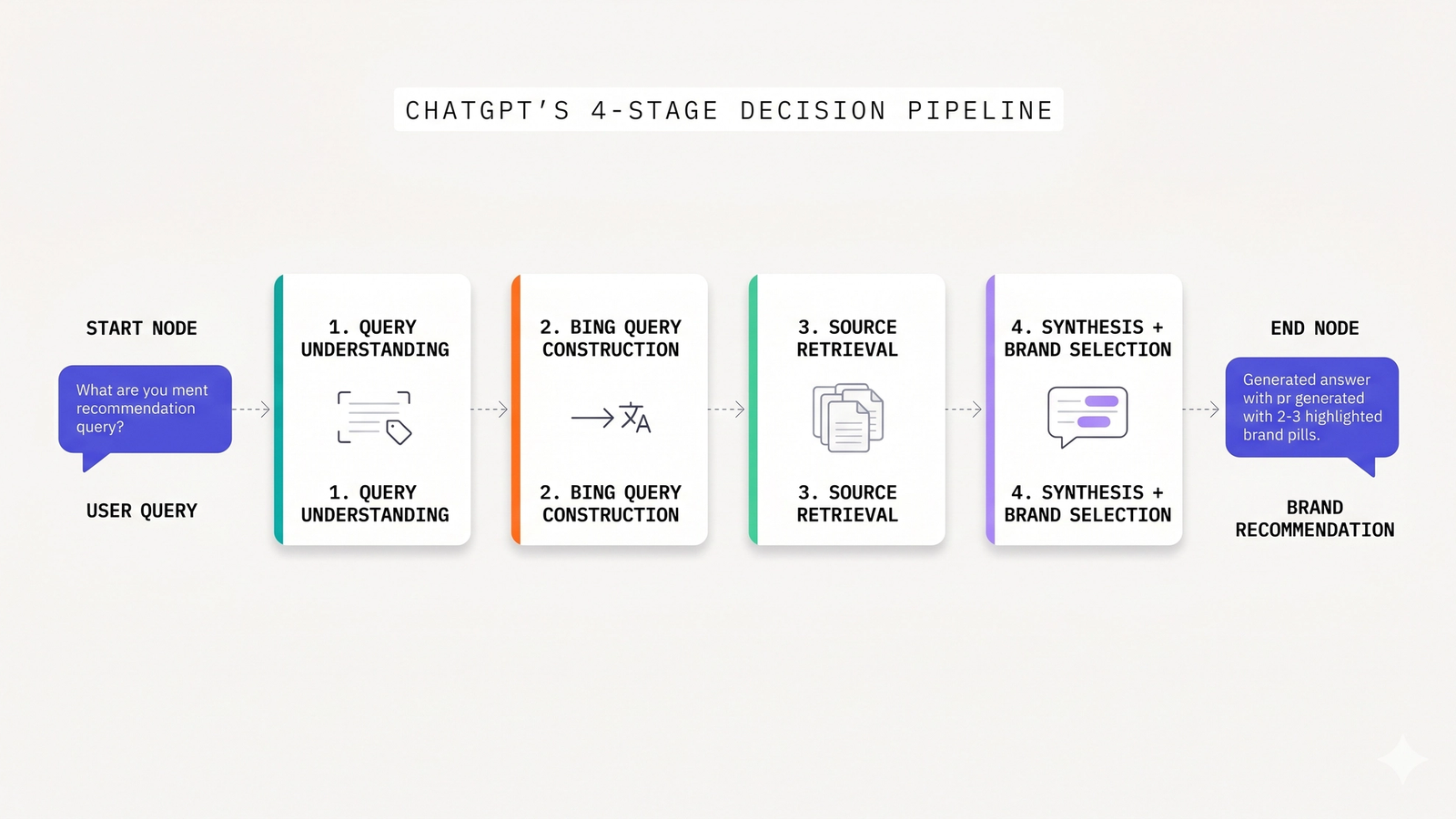
The four-stage pipeline behind ChatGPT brand recommendations — query understanding, Bing query construction, source retrieval, synthesis.
Every B2B founder has watched ChatGPT recommend a competitor and wondered: why them, not me?
The answer is not arbitrary. ChatGPT runs a four-stage decision pipeline when generating brand recommendations, and each stage has specific inputs you can influence. The pipeline is deterministic enough that — once you understand what's happening at each stage — the question shifts from "why aren't I being recommended" to "which stage am I failing at."
This guide walks through ChatGPT's recommendation pipeline end-to-end, what each stage selects for, and how to optimize for it. The conceptual context is in The Four AI Search Platforms Explained. This is the deep dive on ChatGPT specifically.
Two Modes of ChatGPT — Recap
ChatGPT operates in two distinct modes for brand-related queries. The selection logic differs sharply between them.
Trained-knowledge mode — answers from the model's training corpus. Bound by training cutoff. Knowledge of brands depends on whether the brand appeared with sufficient frequency in the training data before that cutoff. Very new brands, recently rebranded brands, or brands without significant English-web presence may be entirely absent.
Web-search mode — the model issues real-time queries against Bing's search index, retrieves source pages, and synthesizes a response grounded in those sources. This is the mode that most consumer ChatGPT recommendation queries trigger today, especially on mobile. The selection logic this guide covers is web-search-mode logic — it's the mode that matters most for brand visibility work.
(For the trained-knowledge horizon, the relevant lever is allowing GPTBot in robots.txt now so your content enters future training cycles. See GPTBot, ClaudeBot, PerplexityBot Explained.)
The Four-Stage Decision Pipeline
When a user asks ChatGPT a recommendation query — "What's the best CRM for a 50-person fintech in India?" — the answer goes through four distinct processing stages before reaching the user. Understanding each stage is how you understand which intervention will actually move your visibility.
Stage 1 — Query Understanding (Intent Classification)
ChatGPT classifies what kind of query it's seeing. Different query types trigger different downstream behaviors:
- Recommendation queries ("best X for Y") → trigger source retrieval focused on comparison and review content
- Comparison queries ("X vs Y") → trigger named-competitor extraction and direct comparison synthesis
- Informational queries ("what is X") → trigger broader source retrieval focused on definitional and explanatory content
- Branded queries ("does X support Y") → trigger source retrieval focused on the named brand specifically
The implication for brand visibility: brands targeting recommendation queries need to be identifiable as a "best for use case Y" candidate. Generic feature pages don't trigger inclusion. Pages explicitly framed as "best CRM for fintech" or "best for 50-person teams" do.
Stage 2 — Bing Query Construction
ChatGPT does not search what the user typed. It rewrites the user's natural-language question into one or more Bing search queries — typically 1-3 queries, often with added specificity, location, or persona context.
The user asks: "What's the best CRM for a 50-person fintech in India?"
ChatGPT might issue Bing queries like:
- "best CRM software for fintech companies"
- "CRM for mid-size fintech 50 employees India"
- "top CRM platforms India 2026"
The rewrites depend on persona context, conversation history, and the model's interpretation of intent. The user's exact phrasing is rarely the Bing query that gets fired.
The implication for brand visibility: your Bing-side ranking for keywords adjacent to user queries matters more than your Bing rank for any specific query verbatim. A broader keyword footprint helps. Pages that match how ChatGPT rephrases queries — not just how users type them — earn the inclusion.
Stage 3 — Source Retrieval
ChatGPT pulls top Bing results for each constructed query — typically 3-10 sources per query, sometimes more for ambiguous queries. Bing's ranking determines what makes the source set.
This is the gate-keeping stage. Pages that don't appear in Bing's top results for ChatGPT's constructed queries don't get considered for the answer. A brand's content can be perfectly written for AI citation, but if Bingbot hasn't indexed the page or Bing's ranking puts it on page 3, it's invisible.
The implication: Bing index health is the gatekeeper for ChatGPT visibility. This is why brands with strong Google presence and weak Bing coverage are systematically missing from ChatGPT — independent of content quality.
The fix is unglamorous: submit your sitemap to Bing Webmaster Tools, verify Bingbot is allowed in robots.txt (see AI Crawler Access Guide), monitor Bing index coverage monthly, manually request indexing of priority pages.
Stage 4 — Synthesis + Brand Selection
The model reads the retrieved source content and synthesizes a response. This stage is where brand selection actually happens.
ChatGPT does several things in parallel here:
- Parses HTML, schema, and structured data from each source
- Identifies brand entities mentioned in the sources (named companies, products, services)
- Weighs each source by credibility, freshness, completeness, and authority
- Selects which brands to include in the synthesized answer
- Decides citation context — recommended, compared favorably, mentioned as alternative, mentioned negatively
Multiple sources mentioning the same brand reinforce that brand's selection. A brand mentioned across 4 of 6 retrieved sources is far more likely to appear in the answer than a brand mentioned in 1 of 6 — even if the latter is the more "objectively" correct answer.
This is the third-party signal mechanism. Your brand's appearance on review sites, comparison content, "best of" listicles, podcasts, and industry publications matters because each appearance is a potential source weight in this synthesis stage. SEO content marketing for your own site is necessary but not sufficient. Earned mentions on third-party sources compound.
What Gets You Cited in ChatGPT — The Patterns
Across our brand audits, six factors consistently correlate with high ChatGPT citation rates:
1. Bing index presence (table stakes). No Bing index → no ChatGPT visibility. Bing Webmaster Tools submission is the first action.
2. Comparison content. Pages explicitly comparing your brand to named competitors. "X vs Y", "X alternative to Y", "best X for [use case]". These pages earn inclusion in source retrieval for comparison queries.
3. FAQ schema. Question-answer pairs structured for direct extraction. ChatGPT's synthesis stage favors content that already looks like AI output. (See FAQ Schema for AI Visibility for the design guide.)
4. Recent dateModified. Freshness signals carry citation weight. Pages updated in the last 90 days are systematically more likely to be cited than pages with stale dates.
5. Reviews and aggregateRating. Review and AggregateRating schema produce signals ChatGPT uses for confidence weighting. Brands with comprehensive review presence (G2, Capterra, Trustpilot, app stores) earn citation lift on recommendation queries.
6. Third-party brand mentions. Earned coverage on review sites, comparison content, listicles, and industry publications. Each mention is a potential source weight in the synthesis stage. Brands with broad earned-media footprints accumulate this advantage.
What Blocks ChatGPT Citation
Three patterns produce zero ChatGPT visibility despite otherwise reasonable SEO foundations:
1. Not in Bing's index
The most common cause. The site exists, ranks well on Google, but isn't covered by Bing — or has been deprioritized in Bingbot's crawl queue. Verify with Bing Webmaster Tools and audit Bing index coverage of priority pages.
2. JavaScript-rendered critical content
Bing's render budget is more constrained than Google's. JS-only rendered content frequently doesn't get parsed at all. If your product information, comparison content, or core brand differentiators only render after client-side JS execution, Bingbot misses them — and ChatGPT never sees them.
Fix: server-side render or pre-render critical content to HTML.
3. Brand-name disambiguation issues
If your brand name is a common noun, a person's name, or shares spelling with established brands, ChatGPT may misroute citations to the wrong entity. The fix is comprehensive Organization schema with full sameAs array (LinkedIn, Crunchbase, Wikipedia where applicable) so the model can disambiguate. (See Structured Data and JSON-LD for AI Search.)
Frequently Asked Questions
Does ChatGPT see my Google rank?
No. ChatGPT's web search uses Bing's index, not Google's. Your Google rank is structurally irrelevant to ChatGPT visibility. (See Why Google Rank Doesn't Predict AI Visibility for the full mechanism.)
How does ChatGPT decide which brands to name in its answer?
Through a four-stage pipeline: query understanding (intent classification), Bing query construction (the model rewrites the user query), source retrieval (top Bing results pulled), and synthesis with brand selection (model reads sources and identifies brands to cite). Brands appearing in multiple retrieved sources are favored.
What's the fastest way to appear in ChatGPT?
Three actions in order: (1) submit your sitemap to Bing Webmaster Tools and ensure Bingbot is allowed in robots.txt; (2) deploy comprehensive Organization and FAQPage JSON-LD on priority pages; (3) publish at least one strong comparison page targeting "X vs [main competitor]" or "best X for [target use case]". Together these move most brands from invisible to occasionally cited within 4-8 weeks.
Does ChatGPT remember brand mentions across user sessions?
ChatGPT's memory feature stores user-specific context across sessions. For brand visibility this means individual users may see biased responses based on their prior interactions. For aggregate measurement, persona-anchored dispatch from clean contexts is required to avoid memory contamination. (See How to Measure AI Search Visibility.)
How do I track if ChatGPT is mentioning my brand?
You need a structured query measurement program. Pick 50-100 representative queries, dispatch them through ChatGPT with persona context, parse responses for brand mentions, compute surface rate per persona. Tools like Citare automate this end-to-end across all four major AI platforms.
Will OAI-SearchBot change this?
OAI-SearchBot is OpenAI's newer live-search crawler, separate from the Bing-grounded web search ChatGPT currently uses. As OAI-SearchBot ramps, ChatGPT's source retrieval may decouple from Bing entirely. This is forward-compatible: allow OAI-SearchBot in robots.txt now alongside GPTBot. (See GPTBot, ClaudeBot, PerplexityBot Explained for the full crawler reference.)
How long until improvements show up?
Bing-side fixes (sitemap submission, robots.txt allowance) typically produce visibility lift in 4-8 weeks as Bingbot recrawls and reindexes. Schema deployment and content depth changes show effect on a similar 4-8 week horizon. Earned third-party mentions compound over months — the slowest but highest-ceiling lever.
Measure Your ChatGPT Surface Rate
ChatGPT's selection logic is deterministic enough that you can measure it. Citare runs persona-anchored query dispatches across ChatGPT, parses responses for brand mentions and citation context, and computes surface rate alongside the other three major AI platforms.
Run your free AI visibility audit → [citare.ai/audit]