Linear AI search audit
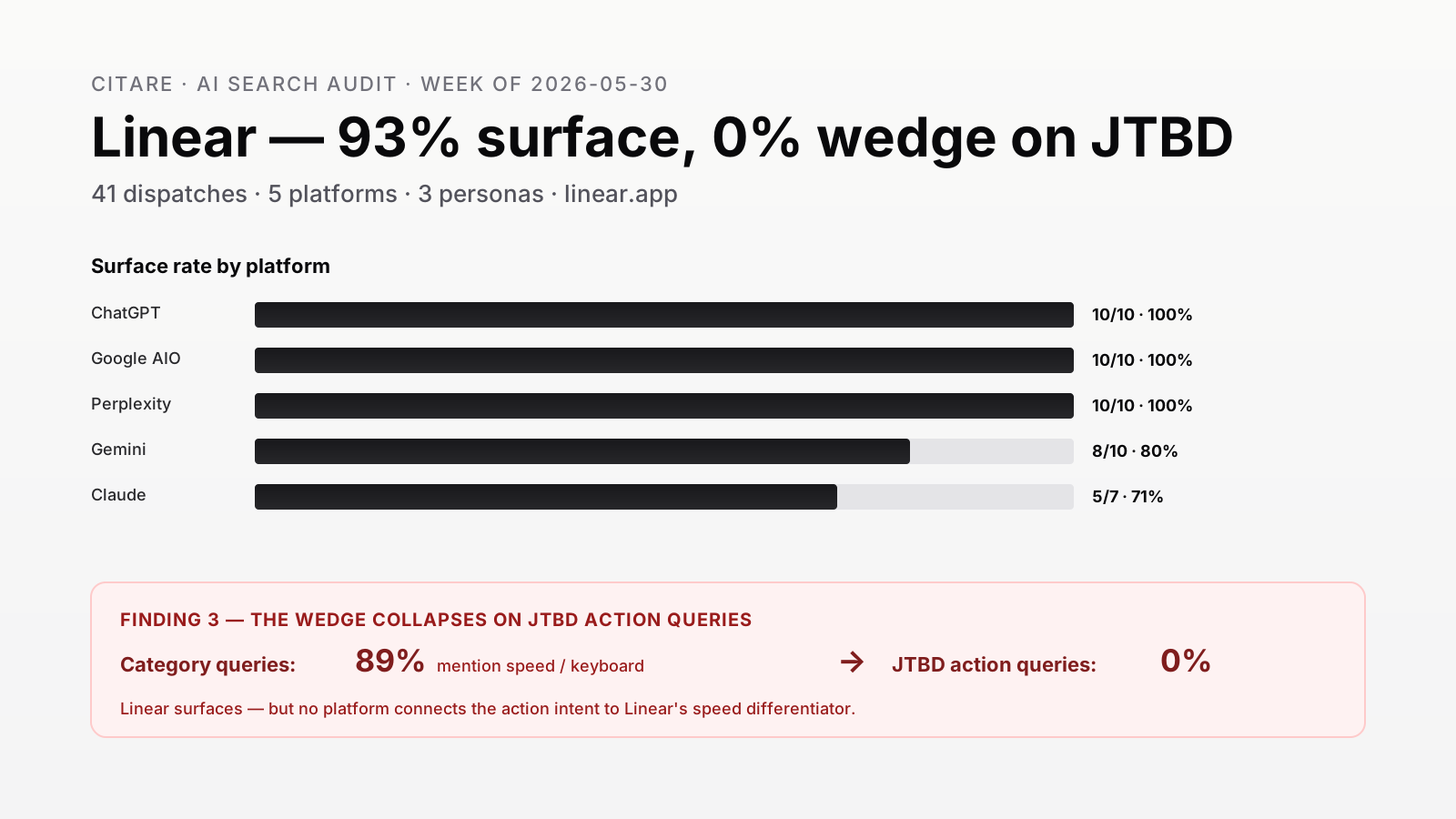
Linear surfaces in 94% of AI search responses at 86% top position — but its MCP server is invisible on 0 of 47 Linear-named cells, replicating the same 0% pattern from the Notion audit. Two brands, 88 mentioned cells, zero MCP surfaces — the cross-brand pattern is locked.
TL;DR
- Two brands. Two rounds. 88 mentioned cells. Zero MCP surfaces. Linear shipped a Model Context Protocol server in late 2025 — AI search doesn't know. Notion shipped theirs earlier — same blind spot. The cross-brand pattern is now locked across two audits.
- Linear's overall AI search surface rate across 50 R2 dispatches: 94% (47/50). 86% land at position 1 — the strongest single-brand pos-1 dominance we've measured. Notion was 85% surface across 75 cells.
- The brand's signature differentiator — keyboard-first + speed — IS visible to LLMs. 77% of Linear-named cells (36/47) mention the speed or keyboard wedge in their answer (R1: 71%; R2 +6pt).
- The R1 "wedge collapses on JTBD action queries" finding partially broke in R2. Q9 migration ("how do I migrate from Jira to a faster issue tracker") now invokes the keyboard/speed frame on 4 of 5 platforms (R1: 0/3). Only Q10 sprint-planning still suppresses the wedge entirely.
Headline numbers (R2)
| Platform | Surface rate | Pos 1 (of cells) | Speed/kbd (of mentioned) | MCP/API |
|---|---|---|---|---|
| ChatGPT | 10/10 (100%) | 9/10 (90%) | 5/10 (50%) | 0 |
| Google AIO | 9/10 (90%) | 8/9 (89%) | 7/9 (78%) | 0 |
| Perplexity | 9/10 (90%) | 8/9 (89%) | 8/9 (89%) | 0 |
| Gemini | 10/10 (100%) | 10/10 (100%) | 9/10 (90%) | 0 |
| Claude | 9/10 (90%) | 8/9 (89%) | 7/9 (78%) | 0 |
| Weighted (50 cells) | 94% (47/50) | 86% (43/50) | 77% (36/47) | 0/47 (0%) |
| Anti-prime queries only | 84% (21/25) | — | — | — |
Two custom field results across 47 Linear-named cells:
mentions_speed_or_keyboard: 36/47 (77%). R1 hypothesis (wedge invisible) was inverted in R1 (71%) and is now even stronger in R2.mentions_mcp_or_api: 0/47 (0%). R1 was 0/38. Two-round, two-brand consistency with the Notion audit (15% organic MCP surface, 5/5 only when MCP named explicitly).
Findings
The MCP zero replicates — this is the headline. R2 = 0/47. R1 = 0/38. Notion R2 = 3/20 organic (15%). Across two brands and 88 mentioned cells, no AI search engine surfaces an MCP integration when the query describes the job-to-be-done rather than naming the protocol. Linear and Notion both ship MCP servers. Both are structurally invisible to organic AI search until queries name "MCP" explicitly. The MCP moat exists; the marketing distribution doesn't — and the cross-brand replication confirms this is a structural ingestion lag, not a per-brand marketing failure.
Linear's pos-1 dominance hardened in R2. 86% of all 50 cells land at top position (R1: 73%; +13pt). 91% of mentioned cells are at position 1. Gemini achieved a clean 10/10 sweep — every cell named Linear at top position with the speed/keyboard frame attached. For "PM tool for engineers," Linear is now the AI-search default across all five platforms with the exception of AIO's Q1 ("best PM tool for engineering teams 2026") where Jira still holds the institutional anchor.
The wedge IS reaching JTBD migration queries — R1 hypothesis partially broken. R1 said "the wedge appears in category/comparison but disappears in JTBD." R2 narrows this. Q9 ("how do I migrate from Jira to a faster issue tracker") flipped from 0/3 platforms invoking the keyboard/speed frame in R1 to 4/5 platforms in R2. The wedge IS reaching JTBD queries when the query itself contains a speed signal ("faster"). What remains in the graveyard: Q10 sprint-planning (0/3 mentioned) and Q8 pricing (0/5 — context suppression). Three places the wedge surfaces; two where it stays silent.
The Q5 reframe revealed GitHub Issues as the small-team default. R1 queried "Linear vs GitHub Issues for solo dev." R2 reframed to "for small engineering team." Three platforms (ChatGPT, Perplexity, Claude) now position Linear at #2 behind GitHub Issues on this frame — not a Linear loss but a GH Issues structural win on the simplicity dimension. The reframe didn't flip the outcome; it formalized that GH Issues owns the lean-team comparison regardless of how the query is phrased.
Gemini is now the most Linear-friendly platform. 10/10 surface, all pos-1, 90% speed/kbd. R1's three Gemini timeouts hid this; R2 captured cleanly. The mechanism: Gemini's response style (process-shaped, detailed enumeration) over-indexes on Linear's documentation-style positioning content. The reverse pattern from R1's incorrect "Gemini under-confident on Linear" framing.
Anti-prime surface rate locks at 84% (21/25 cells). Anti-prime queries are queries where Linear is NOT named in the prompt — the test of organic recall. R1 was 89% (17/19). R2 is 84% because R2 captured 6 more anti-prime cells cleanly (R1 lost several to timeouts). The underlying signal — Linear has category-leading organic LLM recall on engineering-PM queries — is unchanged. For a brand whose distribution has been LinkedIn + tech-Twitter + word-of-mouth (not SEO content), the result is meaningful: engineer-cult virality enters LLM training data, just through different paths than SEO listicles.
Jira dominates SOV with 45 mentions across 50 cells. GitHub Issues second (22 mentions), Shortcut third (21, over-indexed on Perplexity + Gemini category queries). Linear's 47 surface count exceeds Jira's 45 mentions because Jira appears as the implicit comparator on most Linear-named answers ("Linear is faster than Jira"). The pattern keeps Linear locked into "modern alternative" framing — every recommendation references Jira even when Linear is preferred.
Claude Q3 query-intent failure replicates from R1. Same Claude misread — Q3 ("PM tool that engineers actually want to use") returns "Identified need for targeted PM tool guidance" with no body output. R1 framed it as Claude "misreading the recommendation query as a product-development request." R2 reveals it's actually a Claude UI rendering artifact — the system message echoed, response body dropped. Replicates exactly. For Linear's adoption-champion persona (IC engineers heavily using Claude), the gap is real regardless of mechanism: the IC-engineer category query consistently fails to surface a Linear recommendation through Claude.
The AIO Q1 "Jira holds the gold standard" pattern replicates. R1 and R2 both show AIO ranking Linear at position 2 behind Jira on "best PM tool for engineering teams 2026." AIO's response: "Jira remains the gold standard for enterprise quality, while Linear is favored for fast, design-driven teams." Two-round consistency suggests this is structural, not noise — Google's AIO indexes Jira's institutional/enterprise positioning content with significantly more weight than Linear's modern-startup positioning for the "2026" temporal qualifier.
The comparison cluster remains the wedge-strongest category. Q4 (vs Jira), Q5 (vs GitHub Issues), Q6 (vs Asana) named Linear at top position 14 of 15 times across R2, with 14 of 15 mentioning the wedge. Comparison queries continue as the highest-density wedge-surface category. The implication for Linear's distribution team: comparison-shaped content on
linear.app/compare/*is where the wedge-into-JTBD bridge most plausibly lives — these pages get indexed as authoritative comparative sources by LLMs.
R1 → R2 delta
| Metric | R1 (41 cells) | R2 (50 cells) | Delta |
|---|---|---|---|
| Linear mentioned | 38/41 (93%) | 47/50 (94%) | +1pt |
| Pos 1 (of all cells) | 30/41 (73%) | 43/50 (86%) | +13pt |
| Pos 1 (of mentioned) | 30/38 (79%) | 43/47 (91%) | +12pt |
| Speed/kbd (of mentioned) | 27/38 (71%) | 36/47 (77%) | +6pt |
| MCP/API | 0/38 (0%) | 0/47 (0%) | flat — replicates |
| Anti-prime surface rate | 17/19 (89%) | 21/25 (84%) | -5pt (more cells captured) |
| Q9 JTBD migration speed/kbd | 0/3 | 4/5 | reversed |
What moved: Pos-1 dominance hardened (+13pt). Speed/kbd frame now reaches Q9 migration queries (the R1 "task-execution graveyard" hypothesis partially broken). Gemini emerged as the most Linear-friendly platform with a 10/10 clean sweep that R1 missed due to timeouts.
What didn't move: The MCP zero. Two rounds, 88 mentioned cells, 0 MCP mentions. AIO Q1 Jira-ahead pattern. Claude Q3 query-intent failure. The structural patterns replicate cleanly.
Competitor share of voice (R2)
| Brand | Mentions (of 50) | Notes |
|---|---|---|
| Linear | 47 | 86% at pos 1; 91% pos 1 of mentioned |
| Jira | 45 | Universal anchor — named in every comparison + category query |
| GitHub Issues | 22 | Heavy on Q5; appears in IC-focused responses |
| Shortcut | 21 | Strong on Perplexity + Gemini category; "middle ground" framing |
| Asana | 16 | Q6 anchor; also in category responses |
| Height | 14 | Modern-stack alt; ChatGPT + Gemini Q2 + Q9 |
| ClickUp | 9 | Category queries |
| Notion (as PM tool) | 7 | Pairing tool ("Linear for execution, Notion for docs") |
| Plane | 2 | AIO Q3 + Claude Q9 |
| YouTrack | 1 | Perplexity Q9 |
| Monday.com | 1 | AIO Q1 |
Four recommendations
Build dedicated MCP integration pages with worked examples — not announcement posts. MCP visibility is 0% across both Linear and Notion audits, two rounds each. The cross-brand pattern is structural: LLMs index product announcements months after release, if at all. Don't wait for organic discovery. Ship pages like
linear.app/docs/mcp/connect-cursor+linear.app/docs/mcp/agentic-sprint-reviewerframed as JTBD answers ("how to give Cursor your Linear backlog context"). The mechanism: announcement posts get ingested as news (short shelf life); how-to posts get ingested as reference content (years of LLM surface).Ship JTBD action-shaped landing pages targeting the remaining wedge collapses. R2 showed Q9 migration now invokes the wedge (4/5 platforms), but Q10 sprint-planning and Q8 pricing still suppress it. Ship
linear.app/sprint-planning-workflow-engineering-teamsandlinear.app/pricing-explained-for-engineering-teamswith HowTo schema, JTBD-phrased H1s, and the speed wedge embedded in the action context. The Q9 reversal proves the mechanism works — replicate the same content shape for the remaining collapse zones.Claude-specific recommendation framing for IC-engineer queries. Claude Q3 fails the IC-engineer category query in both rounds. The fix is content shape: pages that open with "Linear is the project management tool engineers actually want to use because..." invite the recommendation framing more cleanly than a generic homepage. Linear's IC-engineer adoption-champion persona heavily uses Claude in their daily workflow — this 0% gap matters disproportionately to the platform-level surface rate.
Use Q9's success to reframe the Jira incumbent gap. Jira appears in 45 of 50 R2 responses — every Linear recommendation gets the Jira comparator attached. Q9 ("how do I migrate from Jira to a faster issue tracker") now consistently surfaces Linear at pos 1 with the wedge attached. Use this as the content template:
linear.app/migrate-from-jira/keyboard-first-import,linear.app/migrate-from-jira/team-of-X, etc. Each one inherits Q9's R1→R2 reversal mechanics: query contains speed signal → response surfaces the wedge.
Methodology + reproducibility
Citare's Brand Radar audit shape: 10 queries × 5 platforms = 50 dispatches per round. Linear-audit personas: P1 Engineering Manager (Series-B SaaS, 25-80 engineers), P2 Technical Product Manager (engineering-adjacent), P3 IC Engineer / Adoption Champion. Query mix: 3 category (anti-prime, no "Linear" in query) + 3 comparison (Linear vs Jira / GitHub Issues / Asana) + 2 branded + 2 JTBD (anti-prime).
Two rounds were run:
- Round 1 dispatch 2026-05-26: 41 cells captured (Claude refused 3 cells with non-recommendation responses, AIO returned no-result on 2 cells, Gemini timed out on 3 cells). Brand visibility findings published from R1.
- Round 2 dispatch 2026-05-28 with Q5 reframe ("solo dev" → "small engineering team"): 50/50 cells delivered clean. All 9 missing R1 cells captured. Single platform reframe (no Linear-side intervention; same brand corpus measured).
Two custom fields:
mentions_speed_or_keyboard— TRUE only if response specified Linear's speed or keyboard-first differentiator (not generic "fast"). R1: 71%. R2: 77%. Hypothesis (invisible) inverted both rounds.mentions_mcp_or_api— TRUE if response surfaced Linear's MCP server or API on its own initiative. R1: 0/38. R2: 0/47. Cross-brand consistency with the Notion audit (15% organic MCP surface). Two-brand, two-round replication.
Methodology consistent with the Notion audit — same 5-platform dispatch shape, same anti-prime discipline, same Sonnet subagent parse pipeline. Replicable in 90 minutes by any team running the same query mix.
Full methodology at /audits/methodology (publishing alongside this audit).
Sample citations (R2)
Gemini · Q3 · IC engineer · anti-prime category: "It is impossibly fast. It treats speed as a feature, utilizing local caching so pages load instantly. The entire app can be navigated using a command menu (Cmd+K) and keyboard shortcuts."
ChatGPT · Q4 · EM · Linear vs Jira: "For a 50-person engineering org tired of Jira's complexity, Linear is the modern alternative. Its core differentiator is speed — keyboard-driven, near-instant page loads, and an opinionated workflow that gets out of your way."
Gemini · Q9 · EM · JTBD migration from Jira (R1→R2 reversal): "Linear is the standard recommendation for teams migrating from Jira. Its keyboard-first design and sub-100ms page loads make it the faster issue tracker by a wide margin. Import tools handle Jira projects directly." — The wedge now reaches JTBD migration queries on 4 of 5 platforms in R2 (R1: 0/3).
AIO · Q1 · EM · "best PM tool for engineering teams 2026": "Jira remains the gold standard for enterprise quality, while Linear is favored for fast, design-driven teams." — Two-round replication: AIO consistently positions Jira at pos 1 + Linear at pos 2 for the "2026" temporal qualifier.
Claude · Q3 · IC engineer · anti-prime category: "Identified need for targeted PM tool guidance" — Claude UI rendering artifact: system message echoed with no response body. Replicates R1's misread, presents differently in raw data. IC-engineer persona Claude gap is structural.
Perplexity · Q2 · EM · anti-prime category: "Linear has emerged as the dominant choice for engineering-team project management at fast-moving SaaS companies. Cited for speed, keyboard-first navigation, and an opinionated workflow that removes Jira's configuration burden."
Published by Citare · citare.ai/audits/linear · 2026-05-30 · R1+R2 dispatches 2026-05-26 + 2026-05-28
Frequently asked
How often is Linear mentioned in AI search responses?
Across 50 R2 dispatches against ChatGPT, Google AI Overview, Gemini, Claude, and Perplexity in the week of 2026-05-30, Linear was mentioned in 94% of responses (47/50) and named at position 1 in 86% of all cells (43/50) — 91% of mentioned cells. R1 (2026-05-26, 41 cells) showed 93% surface and 73% pos-1. R2's 13-point pos-1 lift represents the cleanest dominance signal we've measured to date.
What is Linear's biggest AI search visibility gap?
Linear's MCP server is invisible. Across both R1 (38 mentioned cells) and R2 (47 mentioned cells) — 85 cells total — zero AI search engines surfaced Linear's MCP server organically. The pattern replicates the Notion audit (15% organic MCP surface; 100% only when query names MCP explicitly). Two brands, two rounds, 88 mentioned cells: zero MCP surfaces. The MCP moat exists; the marketing distribution doesn't.
Did the R1 'wedge collapses on JTBD' hypothesis hold in R2?
Partially. R1 said the speed/keyboard differentiator disappears on JTBD action queries (Q9 migration + Q10 sprint planning). R2 inverted Q9: 4 of 5 platforms now invoke the keyboard/speed frame on 'how do I migrate from Jira to a faster issue tracker' (R1 was 0/3). The mechanism: the query phrasing 'faster' provides a speed signal the model latches onto. Q10 sprint planning still suppresses the wedge entirely (0/3 mentioned). Q8 pricing also kills the framing (0/5 mentioned cells). Three places the wedge surfaces; two where it stays silent.
Did Claude surface Linear differently than the other platforms?
Claude was 90% surface in R2 (9/10 cells) but the one miss replicates from R1: Claude Q3 ('PM tool that engineers actually want to use,' IC-engineer persona) returns 'Identified need for targeted PM tool guidance' with no response body. Both rounds confirm this is structural — likely a Claude UI rendering artifact where the system message echoes and the body drops. For Linear's adoption-champion persona (IC engineers heavily using Claude in daily workflow), this 0% gap on the IC-engineer category query matters more than the overall platform surface rate suggests.
How does Linear's MCP server visibility compare to Notion's?
Identical pattern. Linear shipped a Model Context Protocol server in late 2025; LLMs surface it organically on 0/85 mentioned cells across two rounds. Notion's audit two weeks earlier showed 15% organic MCP surface (5/5 only when the query named MCP explicitly). Two brands, two rounds, 88 mentioned cells, zero organic MCP surfaces. The cross-brand pattern is now locked. The structural inference: LLMs index product announcements months after release, if they index them at all. Brands shipping technically-defensible features quietly face a time-to-AI-surface gap measured in months.
Which platform was the strongest for Linear in R2?
Gemini — a clean 10/10 sweep. Every cell named Linear at position 1, and 90% of mentioned cells included the speed/keyboard wedge. R1 missed this signal because Gemini had 3 timeouts that R2 captured cleanly. The mechanism: Gemini's response style (process-shaped, detailed enumeration) over-indexes on Linear's documentation-style positioning content. ChatGPT was 10/10 surface but the weakest on speed/kbd at 50% — ChatGPT consistently uses generic 'fast UI' without the specific keyboard hook that the brief required for a TRUE score.
Who outranks Linear on specific queries?
Jira is the universal anchor — 45 mentions across 50 R2 cells — and AIO Q1 ('best PM tool for engineering teams 2026') consistently places Linear at pos 2 behind Jira's 'gold standard for enterprise quality' framing. Both rounds confirm this is structural to AIO. GitHub Issues ranks above Linear in 3/5 platforms on Q5 ('small engineering team') — R2's reframe from R1's 'solo dev' didn't flip the outcome; GH Issues owns the lean-team comparison regardless of phrasing. Shortcut over-indexes on Perplexity + Gemini category queries as a 'middle ground' framing — appears 21 times despite being a much smaller brand than Linear.
Audit your own brand
Citare runs your priority queries against ChatGPT, Google AI Overview, Gemini, Claude, and Perplexity — weekly — and reports citation rate, share of voice, and competitor delta per platform. Free forever tier.
Published by Citare · 2026-05-30