Answer Engine Optimization vs GEO: The Evolution
AEO predates GEO by six years. From voice search to AI assistants — the historical arc of answer-engine optimization and what's the same vs new.
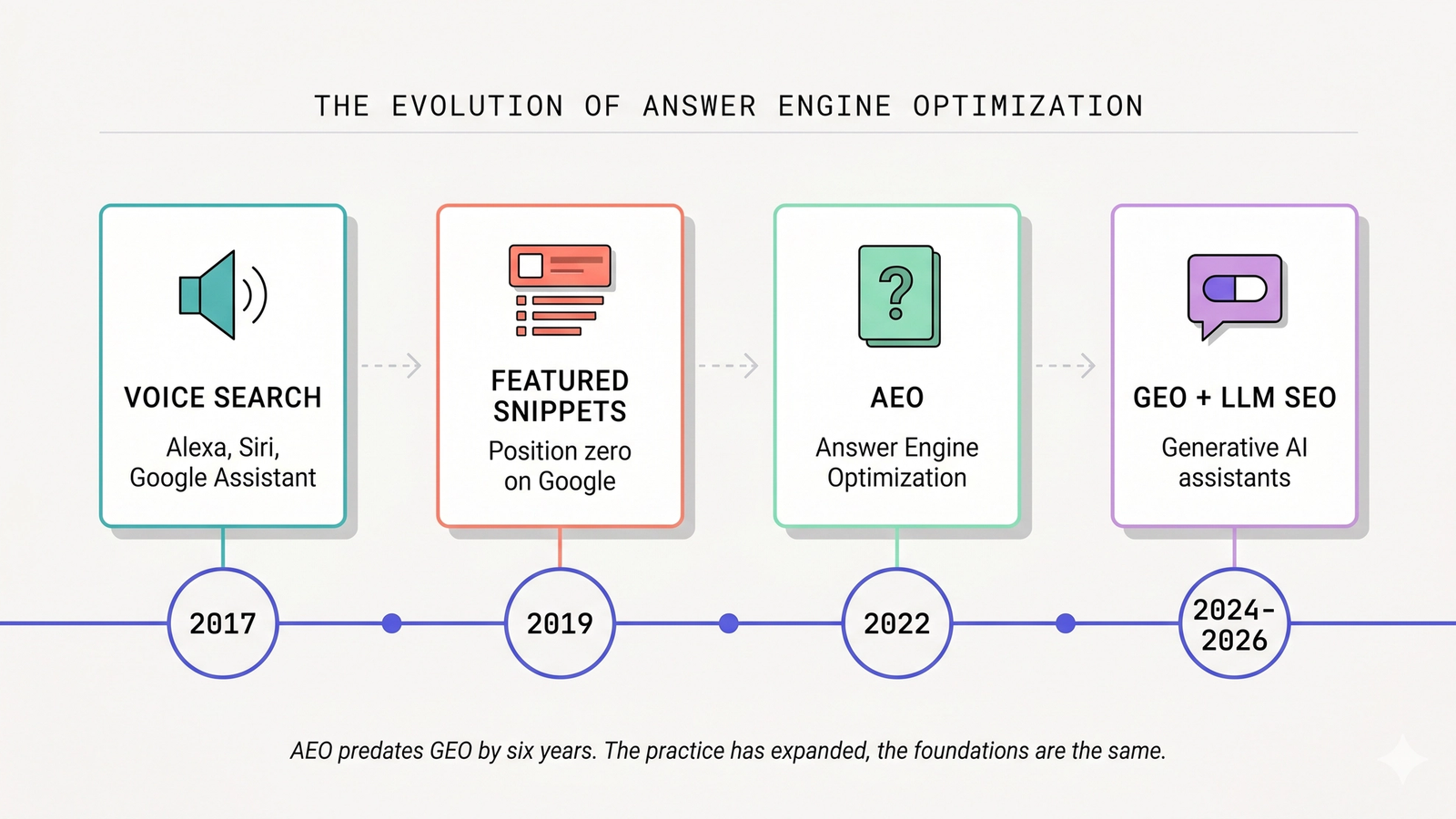
Answer Engine Optimization (AEO) predates Generative Engine Optimization (GEO) by six years. AEO started as voice-search optimization in 2017, expanded to featured-snippet targeting on Google, and got re-purposed for AI assistants when LLM-powered search emerged in 2023.
The term still carries usage in SEO consultant communities and agency-led content. Whether your team uses AEO, GEO, LLM SEO, or AI SEO, the modern practice is the same: optimize content for citation by AI search platforms.
This guide is the historical-arc version of that disambiguation. (For the terminology zoo and full set of names in circulation, see LLM SEO Explained. For the deep practice-vs-practice comparison, see GEO vs SEO.)
What AEO Originally Meant
AEO emerged in 2017 as a discipline within SEO focused on optimizing content for "answer engines" — products that returned a single direct answer rather than a list of links.
The original answer engines:
- Voice assistants — Alexa, Siri, Google Assistant. Users asked a question and the assistant spoke a single answer.
- Featured snippets on Google — the "position zero" snippet box at the top of a SERP that quoted a direct answer from a single page.
- Knowledge panels — Google's structured information cards.
All three returned answers, not lists. AEO was the optimization discipline focused on being the source of those answers.
The original AEO playbook was already converging on the patterns we now recognize as GEO foundations:
- FAQ schema deployment
- Direct-answer-first content patterns ("position zero" required the answer in the first 1-2 sentences)
- Structured data prioritization
- Question-phrasing matching to user query patterns
- Concise, extractable factual claims
These same patterns underpin AI assistant citation today. The mechanism evolved — from snippet extraction to LLM synthesis — but the input format remained largely the same.
What AEO Means Today
After the LLM-powered search era arrived in 2023, AEO got re-purposed. The term now refers to optimizing for AI assistants — ChatGPT, Gemini, Google AI Overview, Perplexity — rather than for voice search and featured snippets specifically.
This re-purposing was natural: the underlying methodology transferred almost directly. The practitioners who'd built AEO competence in the 2017-2022 window were the same practitioners best positioned to build for the AI assistant era. The vocabulary stretched to fit the new technology.
In current usage, AEO is functionally synonymous with GEO and LLM SEO. Some practitioners distinguish:
- AEO emphasizes the answer-extraction layer (how the model picks a passage)
- GEO emphasizes the generative-engine layer (how the model synthesizes a response)
- LLM SEO emphasizes the model layer specifically (large language models as the optimization target)
These distinctions are mostly academic. The methodology, measurement, and outcomes overlap so heavily that any meaningful difference is in the framing, not the practice.
AEO vs GEO — The Historical and Functional Differences
Historical
AEO predates GEO by six years. AEO emerged from voice search and Google featured snippets. GEO was coined specifically for the generative AI era — initially around 2023 alongside the rise of ChatGPT, Bing Chat, and the early Google AI Overview rollout.
If a piece of content references AEO without mentioning LLMs or generative AI, it's likely 2018-2022 era content focused on voice search and featured snippets. Modern AEO content includes the LLM context.
Functional
The practical methodology is nearly identical:
- FAQ schema deployment — AEO (original): Core · AEO (today): Core · GEO: Core
- Direct-answer-first content — AEO (original): Core · AEO (today): Core · GEO: Core
- Structured data prioritization — AEO (original): Core · AEO (today): Core · GEO: Core
- Question-phrasing match — AEO (original): Core · AEO (today): Core · GEO: Core
- Multi-platform measurement — AEO (original): Less applicable · AEO (today): Core · GEO: Core
- Persona-anchored dispatch — AEO (original): Not applicable · AEO (today): Newer · GEO: Core
- LLM-specific optimizations — AEO (original): Not applicable · AEO (today): Yes · GEO: Yes
- Voice search optimization — AEO (original): Core · AEO (today): Optional · GEO: Optional
The overlap is large. The differences are at the edges — GEO and modern AEO are more multi-platform, more measurement-anchored, and more LLM-specific. Original-era AEO was Google-centric and voice-anchored.
Convergence
The terminology is converging toward GEO over the next 12-18 months based on usage trends. AEO will retain usage in:
- Voice search heritage contexts
- SEO consultant communities that built brand around the term
- Agency content marketing in markets where AEO has stronger SEO competition than GEO
LLM SEO will retain usage in developer-leaning communities. AI SEO will persist as informal shorthand. GEO is winning the naming war.
What Still Works from the Original AEO Playbook
The following AEO patterns remain foundational for modern AI assistant optimization:
FAQ schema — Originally deployed for featured-snippet targeting. Now the highest-leverage AIO citation lever. (See FAQ Schema for AI Visibility for the full design guide.)
Direct-answer-first paragraphs — Originally needed for position-zero featured snippets. Now needed for AI extraction across all four major platforms.
Structured data deployment — Originally important for Google rich results. Now the foundation for AI platform extraction. (See Structured Data and JSON-LD for AI Search.)
Question-phrasing in headings — Originally matched voice search query patterns. Now matches AI assistant conversational query patterns.
Concise factual claims — Originally extractable for snippets. Now extractable for AI synthesis.
If your team already built AEO competence in the 2018-2022 era, you have a head start on GEO. The fundamentals transfer.
What's New in GEO That Wasn't in Original AEO
Five practical additions over original-era AEO:
1. Multi-platform reality. Original AEO was Google-centric (featured snippets, knowledge panels, voice assistants surfaced via Google). Modern GEO operates across at least four distinct AI surfaces — Google AI Overview, ChatGPT, Gemini, Perplexity — each with its own index, crawler, and citation logic. Single-platform optimization is incomplete.
2. Citation context attribution. Original AEO measured "did we capture the snippet — yes or no." Modern GEO captures how the brand was cited: recommended, compared favorably, mentioned as alternative, mentioned negatively. Citation context shapes buyer impact in ways binary capture didn't.
3. Surface rate as the metric. Original AEO targeted "position zero" — a binary status per query. Modern GEO measures surface rate — percentage of queries where the brand is cited across personas and platforms. Different metric, different optimization horizon.
4. Persona-anchored dispatch. Original AEO dispatched naked queries (no user context). Modern GEO recognizes that AI assistants produce different responses for different user personas, requiring persona-anchored measurement.
5. Per-platform crawler access. Original AEO needed Googlebot allowed. Modern GEO needs GPTBot, ClaudeBot, PerplexityBot, Google-Extended, and Bingbot — each separately. (See AI Crawler Access Guide.)
These additions don't replace AEO — they extend it.
Frequently Asked Questions
If I learned AEO before, do I need to relearn it for GEO?
No. The fundamentals transfer almost directly. FAQ schema, direct-answer-first content, structured data, question-phrasing matching — all foundational for AEO and remain foundational for GEO. The additions to learn are multi-platform reality, persona-anchored measurement, and per-platform crawler access. About 20-30% new material on top of an 70-80% shared foundation.
Does voice search optimization still count as AEO?
Yes, but it's a smaller share of modern AEO. Voice search is still meaningful — Alexa, Siri, Google Assistant remain in active use — but the share of AEO content focused on AI assistants has overtaken voice-search content. Practical implication: if you're optimizing for voice search, you're already producing AEO-foundational content. Adding GEO-specific layers (multi-platform, persona-anchored, AI crawler access) extends rather than replaces that work.
Should I use the term AEO or GEO with my agency?
If your agency has built brand around AEO, use AEO. If they're using GEO or LLM SEO, use that. Internally, picking one and staying consistent matters more than which term. For forward-compatibility, GEO is the safer choice — the convergence is heading there.
Is featured snippet optimization the same thing as AEO?
Featured snippet optimization is a subset of AEO. AEO covers featured snippets plus voice search plus (in modern usage) AI assistant optimization. If your AEO content was specifically about position zero on Google, it's a subset of the broader discipline.
Does Google still surface featured snippets as a separate result?
Yes, but the prominence has decreased as Google AI Overview rolls out. AI Overview frequently displaces featured snippets at the top of the SERP. Brands that earned position-zero snippets in the AEO era are now competing for AIO citation in their place. The skills transfer; the surface has shifted.
Whether You Call It AEO or GEO — Measure It
Citare measures your brand's surface rate across all four major AI search platforms — the modern incarnation of what was once "position zero" tracking, expanded to multi-platform multi-persona measurement.
Run your free AI visibility audit → [citare.ai/audit]