How Gemini Indexes Brands
Gemini and AI Overview share Google's index but cite differently. The three structural differences and how to optimize for Gemini specifically.
Most marketing teams treat Gemini and Google AI Overview as the same surface because they share Google's index. They aren't.
Gemini surfaces named-competitor comparisons aggressively, weights Knowledge Graph entity signals heavily, and retains conversational state across multi-turn queries in ways AIO doesn't. Same source data, different selection logic, different optimization stack.
This guide walks through how Gemini specifically picks brands to surface, what it rewards beyond what AIO rewards, and the three highest-leverage interventions for Gemini visibility. The conceptual framing is in The Four AI Search Platforms Explained. This is the deep dive on Gemini.
Quick Context — Gemini vs Google AI Overview
Both surfaces source from Google's main index. Both are evaluated by Google-Extended. Both reward structured data, freshness, and source quality. The shared foundation is large enough that optimizing for one helps the other.
But the surfaces are distinct products with distinct routing logic:
- Google AI Overview is the AI-generated answer block that appears at the top of Google search results. Single-shot, designed to satisfy the user without a follow-up.
- Gemini is Google's standalone AI assistant available at gemini.google.com and embedded across Workspace (Docs, Gmail, Drive, Search). Conversational, multi-turn, designed for sustained interaction.
Three structural differences shape how each one selects citations.
The Three Structural Differences
Difference 1: Comparison Aggressiveness
Gemini surfaces named-competitor comparisons even when the user didn't explicitly ask for them. Ask Gemini "is Brand A any good for [use case]?" and the response will frequently include a comparison to Brand B and Brand C — even though the user only named Brand A.
AI Overview is more conservative about this. AIO will surface comparisons for explicit "X vs Y" queries but rarely volunteers competitor mentions for branded single-name queries.
Implication: Comparison content earns disproportionate citation lift on Gemini. Pages explicitly framing your brand against named competitors are surfaced by Gemini even on queries that aren't comparisons. The same content earns less lift on AIO.
Difference 2: Knowledge Graph Weighting
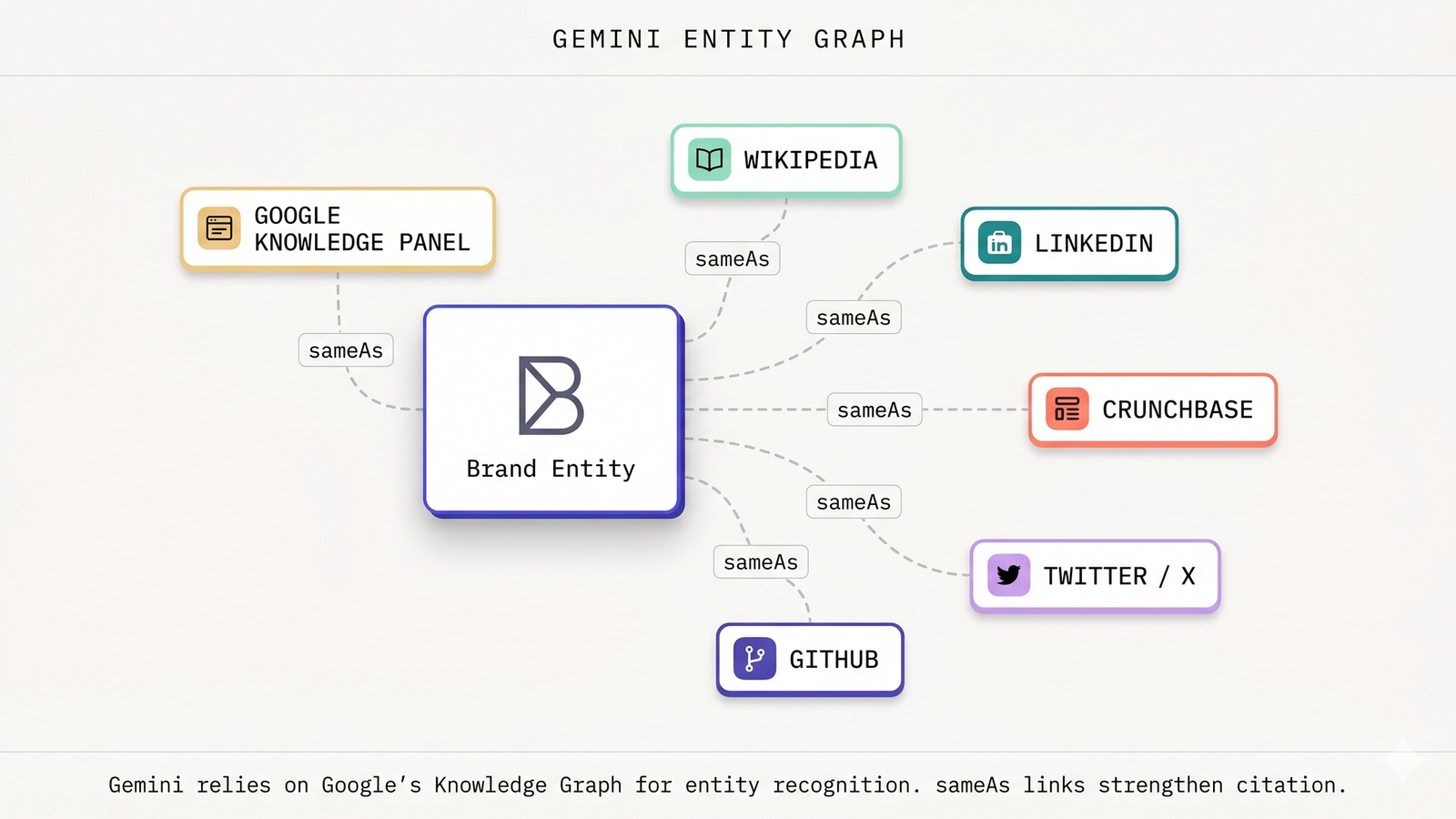
Gemini relies more heavily on Google's Knowledge Graph for entity recognition than AIO does. The Knowledge Graph is Google's structured database of entities — companies, people, places, products, concepts — with their canonical references and relationships.
When Gemini decides whether to cite your brand, it looks up your entity in the Knowledge Graph. If you're a strong entity (Wikipedia entry, comprehensive sameAs, claimed knowledge panel), citation is more reliable. If you're a weak entity (no Wikipedia, sparse sameAs, no knowledge panel), Gemini may misroute citations to a similarly-named entity or skip you entirely.
Implication: Wikipedia presence, sameAs deployment, and knowledge panel claims have outsized leverage for Gemini specifically. The same actions help AIO, but the leverage on Gemini is larger.
Difference 3: Conversational State
Gemini retains context across turns. A user who asked about your brand in turn 1 can ask "tell me more about pricing" in turn 2, and Gemini will produce deeper coverage drawing on its initial source set.
AIO is single-shot — every query is independent. Each AIO answer starts fresh from the SERP context.
Implication: Gemini citations compound across multi-turn conversations. If you earn a citation in the first response to a category query, you get reinforced reference in follow-up turns. Your initial source quality affects not just the immediate citation but the entire downstream conversation.
What Gemini Rewards
Patterns from brand audits where Gemini surface rate is high:
Wikipedia entry (or strong functional equivalent)
Brands with a Wikipedia entry achieve Gemini citation lift that brands without one don't. Wikipedia is the highest-confidence Knowledge Graph signal — the model treats Wikipedia presence as definitive entity confirmation.
If your brand qualifies for Wikipedia (notable, sourced, verifiable), pursue it. If not, the closest functional equivalent is comprehensive Organization JSON-LD with full sameAs array — covered next.
Comprehensive sameAs deployment
sameAs is the JSON-LD property that lists canonical references for your brand entity. LinkedIn company page, Crunchbase profile, Twitter/X handle, GitHub organization, Bloomberg, Wikidata — any platform that maintains a canonical entity record for you.
For Gemini specifically, aim for 5-10 entries minimum. Each addition strengthens entity recognition. Each broken or stale URL weakens it. (See Structured Data and JSON-LD for AI Search for the full Organization schema reference.)
Knowledge panel — claim it if Google has built one
Google sometimes builds a knowledge panel for a brand entity automatically. Check by searching your brand name on Google — if a sidebar info card appears, you have a knowledge panel.
If you do, claim it through Google's verification process. A claimed knowledge panel produces strong Gemini citation signals; an unclaimed one produces weaker signals.
If Google hasn't built a panel for you yet, the path is to strengthen entity signals (Wikipedia, sameAs, structured data, press coverage) and Google will eventually generate one.
Comparison content
Pages explicitly comparing your brand to named competitors earn Gemini citations on a wider range of queries than they earn on AIO. Build comparison pages for your top 4-8 competitor pairings. Structure each with side-by-side feature tables, use-case-specific recommendations, and persona-by-persona framing.
Workspace integration signals
For brands targeting business audiences, Workspace presence matters. Google Business Profile, Maps presence, Workspace marketplace listings (for SaaS), and other Google ecosystem signals strengthen Gemini citation in Workspace contexts. Buyers using Gemini-in-Docs encounter brands differently than buyers using gemini.google.com.
Recent activity
Like AIO, Gemini favors fresh content. Update dateModified quarterly on priority pages. Maintain a publishing cadence — even a small steady output is a stronger signal than sporadic large publishes.
Knowledge Graph Entity Strength — The Leverage Few Teams Understand
Across our Gemini audits, brands that invest deliberately in Knowledge Graph entity strength outperform brands that don't — even when content quality and SEO health are matched. This is the most under-invested lever in Gemini optimization.
What the Knowledge Graph is
Google's Knowledge Graph is a structured database of entities and their relationships. When Google understands "Apple" as a fruit vs "Apple" as a company vs "Apple" as a record label, it's because each "Apple" is a distinct entity in the Knowledge Graph with its own properties, relationships, and disambiguation signals.
For brands, the Knowledge Graph entry powers:
- Knowledge panels in Google Search
- Entity recognition in Gemini and AIO
- "About" data in Google Maps and Google Business Profile
- Cross-product brand surface (Search, Maps, Workspace, Gemini)
How brands enter the Knowledge Graph
Three pathways:
1. Wikipedia. A Wikipedia article about your brand is the strongest Knowledge Graph signal. Wikipedia is the most-trusted source Google ingests.
2. Wikidata. Wikidata is a structured-data sibling to Wikipedia. Brands often get Wikidata entries before Wikipedia articles. Both contribute to Knowledge Graph entity strength.
3. Authoritative sameAs propagation. Comprehensive Organization JSON-LD with rich sameAs linking to LinkedIn, Crunchbase, GitHub, official social channels, industry directories. Google ingests these signals to build entity records.
For brands not yet eligible for Wikipedia, pathway 3 is the immediate-action path.
Practical actions to strengthen entity signals
In rough priority order:
- Audit your Organization JSON-LD
sameAsarray. Aim for 5-10 entries. - Verify all
sameAsURLs are canonical (not redirects, not stale). - Maintain consistent NAP (Name, Address, Phone) data across all directories. Inconsistencies weaken entity confidence.
- Build presence on Crunchbase, LinkedIn Company Page, Wikidata if eligible.
- Pursue Wikipedia eligibility long-term (notable + sourced + verifiable).
- Claim Google knowledge panel if Google has built one.
These actions take time to compound — measurable Knowledge Graph entity strength is a 3-6 month horizon, with continued compounding over years.
Comparison Content for Gemini Specifically
Comparison content is high-leverage for both AIO and Gemini, but the lift on Gemini is larger because of Gemini's comparison aggressiveness.
How to structure comparison content for Gemini citation
A comparison page that earns strong Gemini citations typically includes:
- Title format: "X vs Y" or "X alternative to Y" or "Best X for [use case]"
- First-paragraph direct answer: "X is better for [use case A]; Y is better for [use case B]." Don't bury the answer.
- Side-by-side feature comparison table — Gemini extracts tables directly into responses
- Persona-by-persona framing: "For a 50-person fintech, X is the better fit because…"
- Honest acknowledgment of tradeoffs: "Y has better integrations; X has better pricing for early-stage." Pages that acknowledge their own limitations earn citation lift over pages that don't.
- FAQ section addressing common comparison questions
Naming competitors directly is OK
Most brands hesitate to name competitors. For Gemini optimization, this is a mistake. Gemini surfaces named-competitor content because it matches user query phrasing — users explicitly type competitor names in evaluation queries. Pages that name competitors directly earn citations on those queries; pages that gesture vaguely at "the alternatives" don't.
"Compared favorably" is the high-value citation context
When Gemini cites your brand in a comparison context, the framing matters more than the citation itself. A "compared favorably" mention drives buyer mindshare in ways a "passing reference" mention doesn't.
Pages structured to position your brand specifically — "X is the right choice when [conditions]" — earn "compared favorably" citations. Pages framed as marketing copy don't.
Workspace Integration — The Newer Surface
Gemini in Google Workspace (Docs, Gmail, Drive) is a growing share of Gemini's total query volume. The surface differs from gemini.google.com in important ways:
- Ambient discovery — users encounter brands while doing other work, not while explicitly searching
- Document context — Gemini in Docs has access to the document's content, which biases its responses
- Lower brand-prominence threshold — Workspace Gemini volunteers brands more aggressively because it's "helping with a task"
For B2B brands targeting Workspace-using audiences, this is meaningful. A user writing a vendor-evaluation doc in Google Docs may have Gemini volunteer your brand as a candidate — if your entity signals and comparison content are strong enough.
For now, the optimization actions for gemini.google.com transfer to Workspace Gemini. The shared signals are the same. As Workspace Gemini matures, distinct optimization patterns may emerge.
What Blocks Gemini Citation
Five common patterns produce low Gemini surface rate:
1. Google-Extended blocked in robots.txt. Same as AIO — disqualifies you from Gemini eligibility.
2. Weak entity graph. No Wikipedia, sparse sameAs, missing knowledge panel. Gemini's confidence in your entity is low; citations get misrouted or skipped.
3. No comparison content. Gemini surfaces comparisons aggressively, and brands without comparison content lose the comparison-query share entirely.
4. Generic, undifferentiated content. Gemini's selection model rewards specifics. Pages reading like generic marketing copy earn fewer citations than pages with concrete claims, named alternatives, and use-case framing.
5. JS-only rendering. Like all AI crawlers, Gemini's underlying Googlebot has render budget constraints. Critical content rendered only via client-side JavaScript may not be indexed reliably.
Frequently Asked Questions
Does optimizing for AI Overview automatically help Gemini?
Partially. The shared foundation — Google index health, structured data, freshness, Google-Extended allowance — helps both. The Gemini-specific levers (Wikipedia, sameAs, knowledge panel, comparison content) require additional investment. Plan on 70-80% overlap and 20-30% Gemini-specific work.
Do I need a Wikipedia entry to rank well in Gemini?
No, but it helps disproportionately. Brands without Wikipedia entries can achieve strong Gemini visibility through comprehensive sameAs deployment and earned third-party coverage. Wikipedia is the strongest single signal but not the only path.
How do I claim my Google knowledge panel?
Search your brand name on Google. If a knowledge panel sidebar appears, click "Suggest an edit" or look for the "Claim this knowledge panel" link. You'll be asked to verify ownership through a Google account, social media link, or website. Once claimed, you can edit the panel content and the verification produces strong Gemini citation signals.
Does Gemini cite the same brands AI Overview cites?
Often, but not always. The shared index produces overlap, but the divergent selection logic produces different citations on the same query. Brands strong on entity graph + comparison content out-perform on Gemini relative to AIO. Brands strong on FAQ schema + freshness out-perform on AIO relative to Gemini.
Why is Gemini surfacing my competitors when users ask about my brand?
This is Gemini's comparison aggressiveness in action. Gemini volunteers competitor mentions in branded queries because it's structurally trying to give the user a complete picture. The fix is dual: (1) ensure your own brand earns the primary citation by strengthening entity signals; (2) build comparison content where you position your brand favorably against the competitors Gemini is surfacing. You can't stop Gemini from comparing — you can shape what the comparison looks like.
How do I track my Gemini citations specifically?
Run structured query dispatches against gemini.google.com with persona context. Capture full response text and parse for brand entity mentions. Classify by citation context (recommended, compared favorably, mentioned as alternative). Compute surface rate per persona. Tools like Citare automate this end-to-end. (See How to Measure AI Search Visibility for the full framework.)
Is Gemini in Workspace going to grow as a brand discovery surface?
Yes. Workspace Gemini volume is growing fast as Google rolls out integration deeper into Docs, Gmail, and Drive. For B2B brands, Workspace-context brand discovery — buyers encountering your brand while writing a document about their evaluation process — is a growing channel. The optimization actions for gemini.google.com transfer to Workspace Gemini today.
See Your Gemini Surface Rate
Citare runs persona-anchored Gemini query dispatches across categories, parses responses for brand mentions and citation context, and benchmarks against named competitors so you can see where Gemini is — and isn't — surfacing your brand.
Run your free AI visibility audit → [citare.ai/audit]