How Perplexity Sources Answers
Perplexity uses its own crawler and index, cites with linkable URLs, and indexes a technical/B2B audience. The mechanics + the optimization playbook.
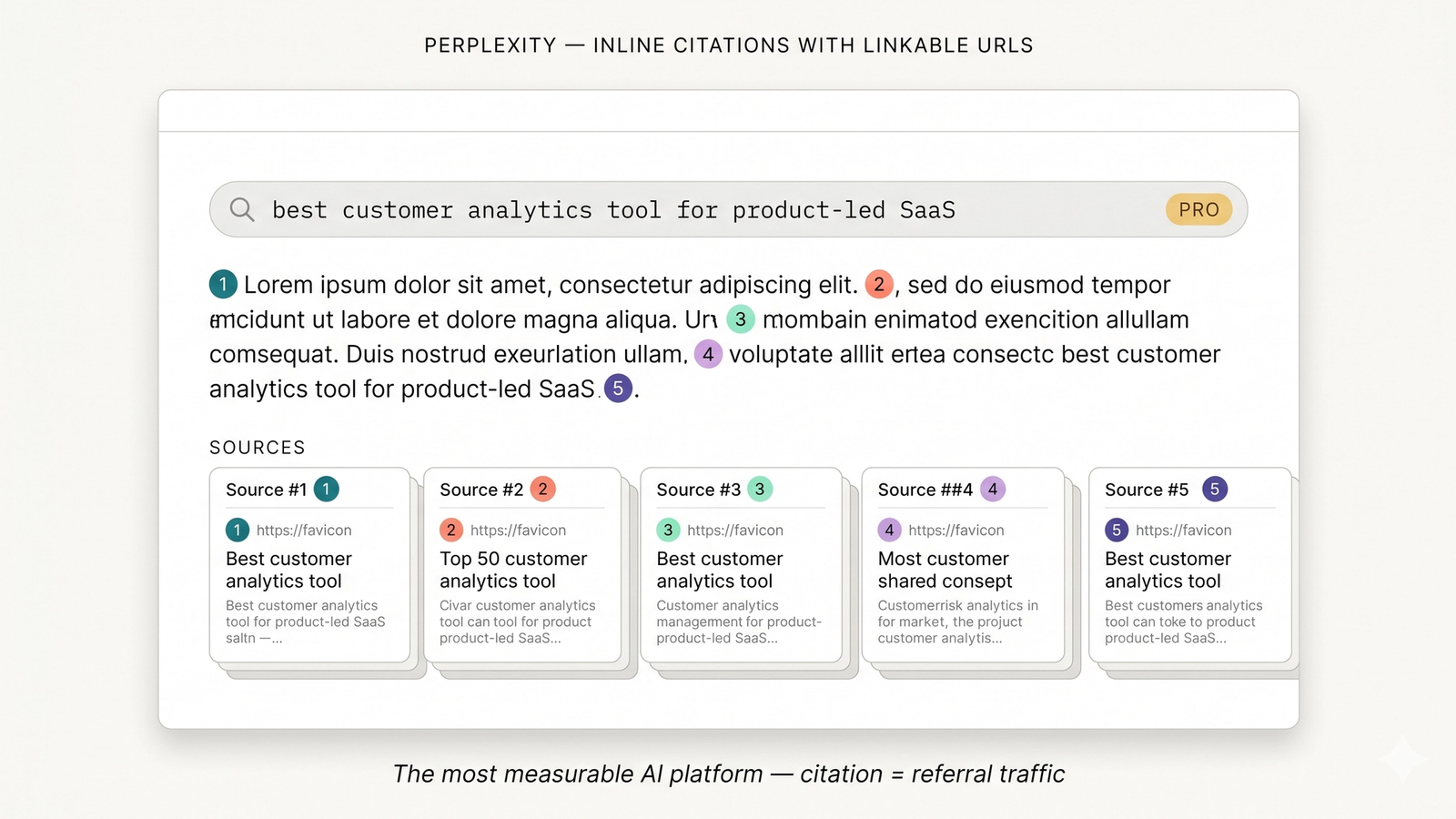
Perplexity is the most measurable, most B2B-relevant, and most under-prioritized AI platform for SaaS and research-led brands.
Three things make it structurally different from ChatGPT, Gemini, and Google AI Overview. First, it runs its own crawler and builds its own index — independent of Google and Bing. Second, every answer includes inline numbered citations with clickable URLs, producing measurable referral traffic in your analytics dashboard. Third, the audience skews disproportionately toward engineers, analysts, decision-makers, founders, and journalists — exactly the buyer personas B2B SaaS targets.
The brands that recognize this pull ahead. In our SaaS audits, brands that invest in Perplexity-specific optimization see 3-4x the surface rate of brands optimizing only for AI Overview. The investment is unglamorous — comprehensive content, original research, source-quality structure — but the leverage is real.
This guide walks through how Perplexity sources answers, what its citation model rewards, the Pro vs free distinction, the Pages content surface, and the priority-ordered playbook for Perplexity visibility. The conceptual context is in The Four AI Search Platforms Explained. This is the deep dive.
Three Things That Make Perplexity Structurally Different
1. Own crawler, own index
Perplexity runs PerplexityBot — its own web crawler — and builds its own search index. It does not rely on Google or Bing. This means Perplexity citation is decoupled from both Google rank and Bing index health.
Practically: a brand can be invisible on Google, missing from Bing, and still appear prominently on Perplexity if PerplexityBot has crawled the site and the content meets Perplexity's source-quality criteria.
For brands with thin Google presence — early-stage SaaS, niche B2B services, research-focused businesses — Perplexity is often the highest-ROI AI platform to optimize for.
2. Inline citations with linkable URLs
Every Perplexity answer includes a list of numbered source citations. The citations are clickable. Users who follow them produce trackable referral traffic with perplexity.ai as the referrer in your analytics.
This is rare among AI platforms. ChatGPT cites sources but the click-through experience is more friction-bound. Gemini cites less consistently. Google AI Overview's source pills are clickable but blend with the broader SERP. Perplexity's inline citations are the most direct citation-to-traffic path on the AI surface.
For brands measuring AI search ROI, Perplexity is the most attributable.
3. Technical / research audience
Perplexity's user base over-indexes on technical, professional, and research-oriented audiences. Engineers. Analysts. B2B decision-makers. Founders. Journalists. Students. Academics.
For B2B SaaS, enterprise software, professional services, finance, and research-intensive verticals, this audience match is significant. Perplexity is the AI platform where your buyer is most likely to be.
How Perplexity Builds and Uses Its Index
Crawl behavior
PerplexityBot follows standard crawl patterns. It respects robots.txt, identifies itself honestly, follows internal links, and indexes parseable HTML. The user agent string is Mozilla/5.0 AppleWebKit/537.36 (KHTML, like Gecko; compatible; PerplexityBot/1.0; +https://perplexity.ai/perplexitybot).
For established sites, expect a refresh cadence of weekly to monthly. Newer sites see less frequent visits initially, ramping up as authority signals develop. (See GPTBot, ClaudeBot, PerplexityBot Explained for the full crawler reference.)
Index plus real-time supplementation
Perplexity's primary source for live answers is its own index. For queries where the index is thin or the topic is recent, Perplexity supplements with real-time web search — fetching live results to fill gaps the index hasn't yet covered.
This means brand visibility on Perplexity has two horizons: the immediate horizon (real-time supplemental search) and the durable horizon (PerplexityBot index inclusion). Allowing PerplexityBot in robots.txt feeds both.
Crawl event = both training input AND live-search input
This is the distinctive structural property. PerplexityBot's crawl serves dual purposes — building the index that powers live search, AND informing model training that improves future ranking. A single crawl event has both immediate visibility and long-term ranking effects.
This makes PerplexityBot crawl access higher-leverage than GPTBot or ClaudeBot crawl access (which serve training only) and arguably higher-leverage than Bingbot or Google-Extended (which serve indexing only). The dual-purpose nature is unique to Perplexity.
The Perplexity Citation Model — What Gets Sourced
In our brand audits, the patterns most predictive of strong Perplexity citation:
Original research and data
The strongest single signal. Perplexity disproportionately rewards original research — proprietary benchmarks, customer outcome data, comparative analyses, trend reports. Pages with original data get cited at far higher rates than pages summarizing other people's research.
For most B2B brands, this is the highest-ROI Perplexity-specific content to produce. A single major research publication can compound citations for months.
Comprehensive guides
Long-form pillar pages with comprehensive topic coverage. The pillar + cluster content architecture serves Perplexity well — pillars earn citations on broad category queries, clusters earn citations on long-tail use-case queries.
Content depth matters more than length. A 2,000-word guide with deep coverage of a topic outperforms a 6,000-word guide with shallow coverage of three topics.
Clear authorship and credibility signals
Perplexity weights author transparency. Pages with explicit author bylines, biographical context, and organizational publisher information earn citation lift over anonymous content. The mechanism is similar to Google's E-E-A-T but Perplexity weights it more heavily.
Recent content
Perplexity favors fresh content. Recent dateModified carries citation weight. Content published in the last 90 days gets cited at higher rates than identical content with older dates. Refresh cadence matters — quarterly updates on evergreen content, monthly on fast-moving topics.
Source-quality formatting
Clean paragraphs. Scannable structure. Clear factual claims. Pages formatted for readability also format well for Perplexity extraction. Walls of text earn fewer citations than well-structured content.
Backlinks (yes, on Perplexity)
Unlike AI Overview where backlinks barely register, Perplexity respects backlink signals. Pages with strong inbound link profiles get cited more reliably than pages without. This is one of the few AI platforms where traditional SEO link-building still produces direct AI search lift.
Pro vs Free — The Routing Distinction
Perplexity Pro users get access to "Pro Search" which routes through more sophisticated model variants and conducts more thorough source aggregation per query.
The differences for brand visibility:
- Pro queries surface broader source sets. More citations per answer (often 6-10 vs 3-5 for free queries). Wider brand coverage.
- Free queries are more constrained. Fewer citations. Tighter focus on the most-confident sources.
For brand measurement, dispatch queries through both routes — the surface rate can differ substantially. Brands with strong Perplexity visibility on Pro queries may be invisible on free queries (and vice versa).
For optimization, the priority order is the same regardless of route. But measurement should account for both.
Perplexity Pages — The New Content Surface
Perplexity's "Pages" feature generates standalone published pages from Perplexity's synthesis of multiple sources, with full source attribution. These Pages are public, indexable, and shareable.
When your brand is one of the cited sources on a Page, two things happen:
1. Citation visibility. Anyone who reads the Page sees your brand listed as a source. The attribution is explicit.
2. Indirect referral traffic. Users who navigate from the Page to your site appear as perplexity.ai referrers in your analytics. Pages that go viral on Perplexity drive measurable referral traffic for cited brands over weeks.
Strategic implication: high-quality original content can produce ongoing referral traffic via Pages — without you publishing the Page yourself. Perplexity's algorithm decides which sources to cite when generating Pages on category-relevant topics. If your content is source-quality, Pages becomes a passive distribution channel.
The Perplexity Playbook — Actions in Priority Order
For a brand starting from zero Perplexity optimization, these actions in order produce most of the achievable lift in 90-180 days:
1. Allow PerplexityBot in robots.txt
Table stakes. Without this, Perplexity cannot index your content. (See AI Crawler Access Guide for the full robots.txt allow list.)
Time to fix: 5 minutes. Time to effect: 4-8 weeks for crawl + index.
2. Publish original research with concrete data
The highest-ROI Perplexity-specific content. Plan one major research publication per quarter — category benchmarks, customer outcome data, comparative analyses, trend reports.
Time to produce: 1-2 weeks per major publication. Time to effect: 8-16 weeks (compounds).
3. Build comprehensive guides
Pillar + cluster architecture. Each pillar covers a category-defining topic comprehensively (3,000-5,000 words). Each cluster targets a long-tail use case (1,500-2,000 words). Internal linking ties the structure together.
Time: months for full architecture. Effect: ongoing citations across multiple query types.
4. Maintain comparison content
Pages explicitly comparing your brand to named competitors. Perplexity surfaces comparison content well, especially on B2B evaluation queries. (See How Gemini Indexes Brands for the comparison-content design pattern — the principles transfer.)
5. HTML-renderable critical content
Avoid JS-only rendering for primary content. PerplexityBot's render budget is constrained; client-side-rendered content frequently isn't parsed. Server-side render or pre-render priority pages.
6. Maintain a publishing cadence
Even a small steady output is a stronger signal than sporadic large publishes. Monthly publishing minimum for active brands. Quarterly refresh on evergreen content (update dateModified after meaningful revisions).
7. Build authoritative inbound backlinks
Perplexity respects backlinks more than AIO does. Earned coverage on industry publications, podcasts, review sites, and authoritative third-party content all feed Perplexity citation signals.
What Blocks Perplexity Citation
Five common patterns produce low Perplexity surface rate:
1. PerplexityBot blocked in robots.txt. Most common cause. Fix immediately.
2. JavaScript-only rendering of critical content. PerplexityBot has a render budget; critical content rendered only via client-side JS frequently isn't indexed.
3. Thin or shallow content. Perplexity rewards depth. Pages under 500 words with no original substance are filtered at the eligibility stage.
4. No clear authorship or credibility signals. Anonymous content gets cited less than content with author transparency.
5. No comparison or research-quality material. Brands without the content types Perplexity rewards earn citations sporadically rather than reliably.
Frequently Asked Questions
Should I prioritize Perplexity over AI Overview?
For B2B SaaS, professional services, and research-intensive verticals: yes, Perplexity often produces higher ROI per hour of optimization investment. The audience match is stronger and the citation linkability produces measurable traffic. For consumer brands, local services, and high-volume D2C, AI Overview should be the priority. For most brands, optimize both — the foundational actions overlap, and platform-specific actions compound.
Does Perplexity actually drive measurable traffic?
Yes. Perplexity citations include linkable URLs that appear as perplexity.ai referrers in Google Analytics and other analytics platforms. Click-through rates from Perplexity citations are meaningful and trackable. For brands with strong Perplexity surface rates, monthly Perplexity referral traffic is a measurable, growing channel.
How is Perplexity different from ChatGPT for B2B brands?
Three differences. (1) Index source: ChatGPT uses Bing's index; Perplexity uses its own. Visibility on each is independent. (2) Citation format: Perplexity citations are inline and clickable; ChatGPT citations are less prominent. (3) Audience: Perplexity skews more technical and professional. For B2B specifically, Perplexity often matches your buyer persona more directly than ChatGPT does.
What kinds of content does Perplexity favor?
Original research and data, comprehensive guides, comparison content, well-structured how-to content, and content with clear authorship signals. The common thread: source-quality material that AI extraction can confidently reference. Marketing copy, thin product pages, and anonymous content earn citations less reliably.
How long until Perplexity citation improvements show up?
For PerplexityBot allow + foundation actions, 4-8 weeks for crawl + index inclusion. For original research and content depth changes, 8-16 weeks for measurable surface rate movement. Compounded gains continue over months as third-party signals (backlinks, citations on other Perplexity Pages) accumulate.
How do I know if my content is appearing on Perplexity Pages?
Check Perplexity Pages directly — search for your category on perplexity.ai/pages and look for your brand cited as a source. Track perplexity.ai referrers in your analytics. For systematic monitoring, structured Perplexity audits with brand-mention parsing are the operational answer.
Should I optimize for Pro Search or free Perplexity?
The optimization actions are the same. Measurement should account for both routes — surface rates can differ. For brands with B2B-decision-maker audiences, Pro Search visibility matters more (Pro is over-represented in B2B usage). For brands with broader audiences, free Perplexity visibility matters more (free is most users).
Measure Your Perplexity Surface Rate
Perplexity is the most measurable AI platform — citations are clickable, referrals are trackable, surface rate is computable. Citare runs persona-anchored Perplexity query dispatches across categories, parses the citation list per response, and benchmarks against named competitors.
Run your free AI visibility audit → [citare.ai/audit]